On the aboriginal inhabitants of the Andaman Islands / by Edward Horace Man. With report of researches into the language of the South Andaman Islands by A. J. Ellis.
- Man, Edward Horace.
- Date:
- [1932]
Licence: In copyright
Credit: On the aboriginal inhabitants of the Andaman Islands / by Edward Horace Man. With report of researches into the language of the South Andaman Islands by A. J. Ellis. Source: Wellcome Collection.
Provider: This material has been provided by London School of Hygiene & Tropical Medicine Library & Archives Service. The original may be consulted at London School of Hygiene & Tropical Medicine Library & Archives Service.
317/334 page 61
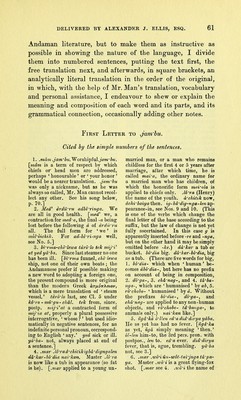
![Andaman literature, but to make them as instructive as possible in showing the nature of the language, I divide them into numbered sentences, putting the text first, the free translation next, and afterwards, in square brackets, an analytically literal translation in the order of the original, in which, with the help of Mr. Man’s translation, vocabulary and personal assistance, I endeavour to shew or explain the meaning and composition of each word and its parts, and its grammatical connection, occasionally adding other notes. First Letter to .janrbu. Cited hy the simple numbers of the sentences. 1. .mam Worshipful.yB»»'}((. \>ndm is a term of respect by which chiefs or head men are addressed, perhaps ‘ honourable ’ or ‘ your honor ’ would be a nearer translation, .janrbu was only a nickname, but as he was always so called, Mr. Man cannot recol- lect any other. See his song below, 2. Med’ ardu'ru adbe'ringa. We are all in good health, [nied’ we, a contraction for med-a, the final -a being lost before the following d of drdirru all. The full form for ‘ we ’ is mbl'bichik. For ad-be-ri-nga well, see No. 5.] 3. brnna-che'lewa tdrd'lo tek mij'i’ at yed yd'ba. Since last steamer no one has been ill. \brrma funnel, che lewa ship, not one of their own boats; the Andamanese prefer if possible making a new word to adopting a foreign one, the present compound is more original than the modern Greek aTgoirKoiov, which is a mere translation of ‘ steam vessel.’ tdro-lo last, see Cl. 5 under kb'ro ~ mwgu-chdl. tek from, since, postp. mij-i’at a contracted form of mij'ia at, properly a plural possessive interrogative, ‘ whose ? ’ but used idio- matically in negative sentences, for an indefinite personal pronoun, correspond- ing to English ‘ any.’ yed sick or ill. yd-ba- not, always placed at end of a sentence.] 4. .mar .lo'rad'chitik'tgbd'digngalen dd'kar-bo'dia na'vkan. Master .lo'ra is now like a tub in appearance (so fat is he). [.»i«r applied to a young un- married man, or a man who remains childless for the first 4 or 5 years after marriage, after which time, he is called mai-a, the ordinary name for a married man who has children, of which the honorific form marola is applied to chiefs only. .U'ra (Henry) the name of the youth, a'chitik now, dchi'baiyaiiiea. ig-b&'dig-nga-len ap- pearance-in, see Nos. 9 and 10. (This is one of the verbs which change the final letter of the base according to the sufiix, but the law of change is not yet fuUy ascertained. In this case g is apparently inserted before -re and -nga, but on the other hand it may be simply omitted before -ke.) dcrkar a tab or bucket, bd'dia big. da-kar-bb’dia, big as a tub. (There are five words for big, 1. bo'dia- which when ‘human’ be- comes dbb'dia-, bnt here has no prefix on account of being in composition, 2. db'ga-, 3. eh&'nag-, and 4. ta'ba- nga-, which are ‘ humanised ’ by ab, 5. rb'chobo- ‘ humanised ’ by d. Without the prefixes bd'dia-, dd-ga-, and eha'nag- are applied to any non-human objects, and rd'chobo- t&'banga-, to animals only.) wai'Aaw like.] 5. ngd'kd d'llen ed'adid'diryaydba. He as yet has had no fever, \ngd-ka as yet, ngd simply meaning ‘then.’ dl-hn him-to, the 3rd pers. pron. with postpos., len to. ed'a ever, did'dirya lever, that is, ague, trembling, yd-ba not, see 3.] 6. .mar .wd'iun-wdt-tai'jngata-pa- ya. Master .wd'i is a great flying-fox shot, [.war see 4. .ud-i the name of](https://iiif.wellcomecollection.org/image/b24764413_0317.jp2/full/800%2C/0/default.jpg)