On the aboriginal inhabitants of the Andaman Islands / by Edward Horace Man. With report of researches into the language of the South Andaman Islands by A. J. Ellis.
- Man, Edward Horace.
- Date:
- [1932]
Licence: In copyright
Credit: On the aboriginal inhabitants of the Andaman Islands / by Edward Horace Man. With report of researches into the language of the South Andaman Islands by A. J. Ellis. Source: Wellcome Collection.
Provider: This material has been provided by London School of Hygiene & Tropical Medicine Library & Archives Service. The original may be consulted at London School of Hygiene & Tropical Medicine Library & Archives Service.
319/334 (page 63)
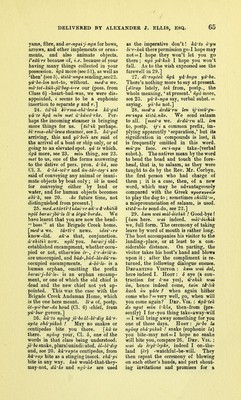
![who dwells at Ross. see No. 11, in relation to taste or mouth, td bone, that is, taken together, A-kdtu bone covering food i.e. shell, ig-bd'di-ke see-wiU, see 4, pres, for fut.] 12. ngol 6‘llen igbd'di yd'te wai'Jcan ttgah-ped'inga Inch'ikan-navlean tdr- chi'ke; bad i u'cha d'ledtu'da ! On seeing it we are sure you will slap your side and exclaim : what a whopping big shell! \ngdlyo\i. o-l-len it, oh], igbd'di see, see 4. yd'te who, see 11 ; that is, you who-see it. wai-kan cer- tainly. ngab your, see Cl. 1 and Om. 4 for the omission of ehdxi- body, or some such word. ped'i-nga slap (verbal subs.) = slapping, kich'ikan and nni'kan both mean ‘ like ’ and to- gether, ‘justlike.’ say-will. bad'i exclamation of surprise, ii'cha this, d'kd-td shell, see 11.] 13. med' drdwru .pu'lo-pildw el-d'r- jana bud lo'yaba yd'te len d'kangai're. We all went to .ptrlo-pildir, which is a village a long way off to the north. [med' drdu'ru we all, see 2. .pu'lo- pildw name of a place in the Nicobar Islands, el-d'rjana north,e/-i^ffi'-south (district), el-d-rmwgu- (appearing-face) east (in these words el stands for e'r- country),idr.j«M'^M-(disappearing face) west. bud hut, village. lo'yaba distant, yd'ie which. to, postp., affecting the whole phrase, which means: to P. P. which is a distant village to the north, d'kan-gai' go a sh ort j ourney by water, d • to-ju'mu is used for a long journey, -re past time.] 14. kd'to d'rla jl'baba pbl'ire. We stayed several days there. [d;d'<o there. d'rla days, plural indicated by the fol- lowing word, jl'baba several, very many, see Cl. 5. pol'i-re dwell-did, see 11.] 15. charkd'r leb rb'go jad'ijo'g dr- du'ru igal're db'na mo'to-kukli're yd'bada. We bargained for a lot of young female pigs for Government, but did not forget ourselves, [charkd'r Andamanese attempt to pronounce the Hindi Sarkd'r government, leb for, postp. rb'go pigs, plural indicated by the following d> du-ru, rb'go- is a female pig, reg- either male or female, jad'i- jb'g spinster, implying a full-grown sow-pig which has not littered, see the mode of expressing sex mentioned on p. 63. drdu'ru several (see Cl. 5) or all, as in 2. Igah-re barter did. db'na but. mb'to ourselves. kuklVre for- get-did. b'to-kukli'-ke oneself forget- does (mb'to is only the form of the first person plural, see p. 58), was one of the new words discovered by Mr. Man from the dictation of these letters to jum'bu. The common verb for forgetting is bt-kukll'ke, which is re- flective, db (C bt-kukll're, I forgot, where db d’ or dbl d’ answers to French je me (in je m'en souviens) and similarly ngb' ng’ or ngbl ng' bt-kukll're you forgot. The relation of b'to-k. and bt-k. is similar to that in btrd'jke de- fend-does, b-tord'jke oneself defend does. ‘ Selves’ isalsoexpressedby e’Aaw. See examples in 40. yd'bada not, see 7.] 16. klanchd' reg-wd'ra gb'i jl'baba mb'yui-ie'mar leb b'more. We accord- ingly fetched several prime young male pigs for our own use. [klanchd' therefore, reg pigs, either male or female, see 15. wd ra bachelor, youTig but full grown, see p. 63. gb'i fresh, and hence in good condition. jl-baba several, properly ‘ very many,’ see Cl. 5, but as there were really only five or six, Mr. Man translated the word ‘ several ’ at the time; he supposed that the young men wished to surprise their friends at Viper by leading them to suppose by this tenn that they had got many more pigs than was actually the case, mb'yut-te'mar ourselves, the meaning of the separate words is not known, but we have db'yttn-t. myself, ngb'yun-t. thyself fcadbyun-t. himself,o‘yM< Lthemselves, ngb'yut-t. yourselves. Ub for, postp. b'mo-re fetch-did.] 17. med'a ngd'kd mdk'nga-ba yd'te len chl'lyuke. Those we have not eaten yet we are fattening, [med'a we. ngd'kd as yet, see 5. mdk'-nga eat- (passive participle, p. 55, n. 2) = eaten, ba not. yd'te which, len postp. pointing out object, meaning: we are fattening those which have not been eaten as yet. The construction, though common, is somewhat involved, and would be, in English order, as boys “construe” Latin: med'achl'lyuke are fattening, len (mark of accusative relation), yd'te (those) which, ngd'kd as yet, mak'nga-ba (are or have been) eaten-not.] 18. d'kdlb'dongalen med'a d'kd- jai'ngke tdrb'lolen btnd'ba rb'go Ib'inga be'dig .bai'par lat mit'ik-l'kke. These we will slaughter one by one, and](https://iiif.wellcomecollection.org/image/b24764413_0319.jp2/full/800%2C/0/default.jpg)