On the aboriginal inhabitants of the Andaman Islands / by Edward Horace Man. With report of researches into the language of the South Andaman Islands by A. J. Ellis.
- Man, Edward Horace.
- Date:
- [1932]
Licence: In copyright
Credit: On the aboriginal inhabitants of the Andaman Islands / by Edward Horace Man. With report of researches into the language of the South Andaman Islands by A. J. Ellis. Source: Wellcome Collection.
Provider: This material has been provided by London School of Hygiene & Tropical Medicine Library & Archives Service. The original may be consulted at London School of Hygiene & Tropical Medicine Library & Archives Service.
320/334 (page 64)
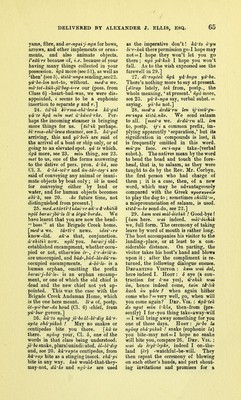
![afterwards get some more pigs to take with us to Viper, [u'kd-lo-do-nga one by one, idiomatic expression, origin un- known. len postp. marks the object. med'a we. slaughter-do, this expression is used for pigs only. tdro’lo.len last-to, afterwards, see Cl. 6. ot-nA'ba other in addition to the former, see Cl. 6 for dt, this prefix also occurs in ot-pag'i once more, rd'go pig, see 15. lo'i-nga get-(verbal subs.) = getting. be-dig while, or consequent upon; meaning: afterwards on getting ad- ditional pigs, .bai-par Andamanese mispronunciation of Viper, an island within the inlet of Port Blair, lat to, postp. ntit-ik in company with us, m- us, ii’fAincompanywith.i'Ar-Actake away-will, see 20.] 19. .mar .vra-.jb'do .mar .wb’i lot pij len jd'bag td'la-tim're. Master .i-ra-.jb.dohaa tonsured Master .wd'i Tery badly, [.mar. see 4. .x-ra-.jo'do is the subject of the verb, .tco't lot pij is the object, as .wd-i's hair, lot his (head understood), see Cl. 6, and Om. 1. pij hair, the usual form of pid in construction, thus bt-pi'j^d-ba- his (head)-hair-not= bald, len postp. obj. jd'bag badly, t&'la-tim're ton- sure-did. This shaving of the crown of the head is the business of the women and especially of the wife, but in this case the women were left behind. The razors used are extremely fine chippings of glass.] 20. tnb'da ,6’ra-.bvela abi-k-y&'te A'chitikigb&'dikengA wavkanbtje-rnga- len igped'ike bl-bi'dig abto-goke. If .wo’i'e, wife .6-ra-.bi-ela were now to see him, she would certainly box the barber’s ears and abuse him. [mb'da if. ab-l'k (female)-take away, yA-te who, that is, who is wife. For ik see end of 18, where, but for the mit-ik, there would have been the prefix ab as abi-kke take-away-does (present), an animate object. But en'i is to take, as abli'ga lA'ka-bang tek palp en‘ikeekvWA. its-mouth from pipe take-do = take the pipe from the child’s mouth, -ke being also used for the imperative. Now in marrying, the chief who unites the couple td-t-yA-p-ket\reir (persons. Cl. 6) -speak-does, the man nd-en-i-ke (ani- mate, see No. 6) -take-does, the woman ab-i-k-ke (human. No. 4) -take-away- does. The husband is spoken of as ad-i-k-yA-te-, and the wife as ah-i-k- yA-te-, as here. For the first few weeks the young couple are called bng-tdg- go-i- their-bed-of-leaves-fresh, and after that for the first year un-jA-ti- go-i-, where un refers to the hands. No. 7, and g5-i is fresh, but ja-ti is not known. A-chitik now, see 4. ig-bd-di-ke see-does, see 4, pres, time, though in English it becomes past subjunctive, after mo-da if. ngA then, see 5. wai-kan certainly, dt- je-r-nga his (head understood, see Om. 1) -shave-(verbal. subst.), that is, his head’s shaver, lexi postp. marking object, ig-ped-i-ke face (see Nos. 9, 10 and 17, and Cl. 4), (in anger) slap (see 12) will, ar-ped-i-ke would be, ‘leg (see Cl. 2) -slap-will,’ as women do when delighted, ol-be-dig it-while or it-after, used for‘and.’ or ‘as well as.’ ab-to-go-ke (human prefix No. 4)-abuse-wiU.] 21. .mar .wd'i bttek-iknga be-dig pij-go-i len enbtje-rke ya-ba. Master .v)o-i is so ashamed of his appearance, that he is letting the new hair grow. \ot-tek-ik-nga for-his-head (Cl. 6), -ashamed-(verbal subst.), iek-ik be -ashamed, but t‘e-kik weep, be-dig consequent on, see 11. pij-go-i hair- fresh. len postp. marking object. en-bt-je-r-ke cause-head-shave-does, en prefixed gives a causal signification to the verb = causes his head to be shaven. yd-ba not.] 22. med-a ydt bd ngol ititd-n yA-te len 6-rokre. We duly obtained the few presents you sent, \_med-a we. ydt properly fish, food, see 10, here presents, ba few, little, a father or mother having one or more little ones is called unbd-da. ngol you. ititA-n send away any animate or inanimate thing, entitA-n send away a human object, en-itAn shew (v. refl.), itA-n permit. yA-te which. len postp. marking the whole phrase as an object. 6-rok-re obtain-did.] 23. ngot pai-chalen min ardwru oteg-nga VedA-re ngA itUA'nnga yd-- balen med-a mb-tot-kukjd-bagire. As you have so much in the “ go-down ” (store), we were much disappointed at your not sending more, \ng5t your. Cl. 6. pni-eha-len lap-to, that is, in your possession, min thing, plural only indicated by following word, drdu-ru several, see 15. ot-jeg--na. Cl. 6, collec- tion of shell-fish, meat, jack-fruit seeds, iron, flint, or anything in a heap, but ot-pii-j-nga is used for honey, fruit.](https://iiif.wellcomecollection.org/image/b24764413_0320.jp2/full/800%2C/0/default.jpg)