The surgical treatment of the diseases of infancy and childhood / by T. Holmes.
- Timothy Holmes
- Date:
- 1868
Licence: Public Domain Mark
Credit: The surgical treatment of the diseases of infancy and childhood / by T. Holmes. Source: Wellcome Collection.
437/700
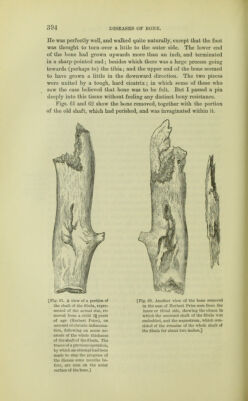
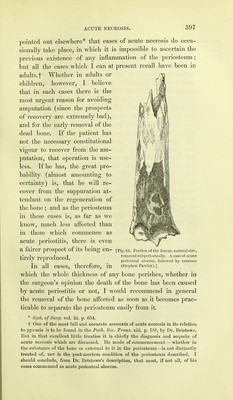
![pointed out elsewhere* that cases of acute necrosis do occa- sionally take place, in which it is impossible to ascertain the previous existence of any inflammation of the periosteum ; but all the cases which I can at present recall have been in adults, t Whether in adults or children, however, I believe that in such cases there is the most urgent reason for avoiding amputation (since the prospects of recovery are extremely bad), and for the early removal of the dead bone. If the patient has not the necessary constitutional vigour to recover from the am- putation, that operation is use- less. If he has, the great pro- bability (almost amounting to certainty) is, that he will re- cover from the suppuration at- tendant on the regeneration of the bone ; and as the periosteum in these cases is, as far as we know, much less affected than in those which commence as acute periostitis, there is even a fairer prospect of its being en- [Mg. 64. Portion of the femur, natural size, tirely reproduced. removted a case of acute J i periosteal abscess, followed by necrosis In all cases, therefore, in (Stephen Pawiey).] which the whole thickness of any bone perishes, whether in the surgeon's opinion the death of the bone has been caused by acute periostitis or not, I would recommend in general the removal of the bone affected as soon as it becomes prac- ticable to separate the periosteum easily from it. * Syst. of Surg. vol. iii. p. 654. f One of the most full and accurate accounts of acute necrosis in its relation to pyaemia is to be found in the Path. Soc. Trans, xiii. p. 188, by Dr. Bristowe. But in that excellent little treatise it is chiefly the diagnosis and sequelae of acute necrosis which are discussed. Its mode of commencement — whether in the substance of the bone or external to it in the periosteum—is not distinctly treated of, nor is the post-mortem condition of the periosteum described. I should conclude, from Dr. Bristowe's description, that most, if not all, of his cases commenced as acute periosteal abscess.](https://iiif.wellcomecollection.org/image/b20416325_0437.jp2/full/800%2C/0/default.jpg)