The surgical treatment of the diseases of infancy and childhood / by T. Holmes.
- Timothy Holmes
- Date:
- 1868
Licence: Public Domain Mark
Credit: The surgical treatment of the diseases of infancy and childhood / by T. Holmes. Source: Wellcome Collection.
531/700
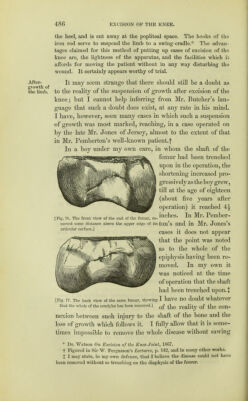
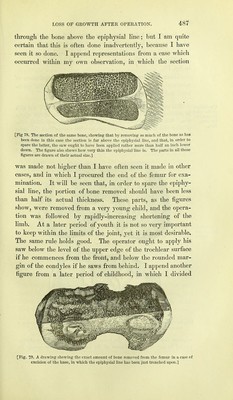
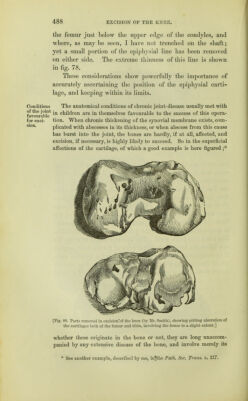
![through the bone above the epiphysial line; but I am quite certain that this is often done inadvertently, because I have seen it so done. I append representations from a case which occurred within my own observation, in which the section [Pig 78. The section of the same hone, showing that by removing so much of the bone as has been done in this case the section is far above the epiphysial line, and that, in order to spare the latter, the saw ought to have been applied rather more than half an inch lower down. The figure also shows how very thin the epiphysial line is. The parts in all these figures are drawn of their actual size.] was made not higher than I have often seen it made in other cases, and in which I procured the end of the femur for exa- mination. It will be seen that, in order to spare the epiphy- sial line, the portion of bone removed should have been less than half its actual thickness. These parts, as the figures show, were removed from a very young child, and the opera- tion was followed by rapidly-increasing shortening of the limb. At a later period of youth it is not so very important to keep within the limits of the joint, yet it is most desirable. The same rule holds good. The operator ought to apply his saw below the level of the upper edge of the trochlear surface if he commences from the front, and below the rounded mar- gin of the condyles if he saws from behind. I append another figure from a later period of childhood, in which I divided [Fig. 19. A drawing showing the exact amount of bone removed from the femur in a case of excision of the knee, in which the epiphysial line has been just trenched upon.]](https://iiif.wellcomecollection.org/image/b20416325_0531.jp2/full/800%2C/0/default.jpg)