The surgical treatment of the diseases of infancy and childhood / by T. Holmes.
- Timothy Holmes
- Date:
- 1868
Licence: Public Domain Mark
Credit: The surgical treatment of the diseases of infancy and childhood / by T. Holmes. Source: Wellcome Collection.
532/700
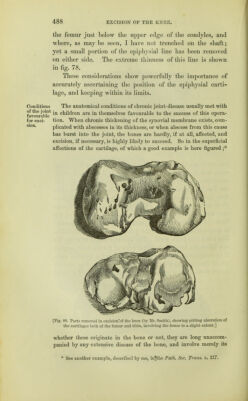
![the femur just below the upper edge of the condyles, and where, as may be seen, I have not trenched on the shaft; yet a small portion of the epiphysial line has been removed on either side. The extreme thinness of tins line is shown in fig. 78. These considerations show powerfully the importance of accurately ascertaining the position of the epiphysial carti- lage, and keeping within its limits. Conditions The anatomical conditions of chronic joint-disease usually met with ityourable *Q cn^<^ren are iQ themselves favourable to the success of this opera- tion. When chronic thickening of the synovial membrane exists, com- plicated with abscesses in its thickness, or when abscess from this cause has burst into the joint, the bones are hardly, if at all, affected, and excision, if necessary, is highly likely to succeed. So in the superficial affections of the cartilage, of which a good example is here figured ;° for exci- sion. [Pig. 8ft. Parts removed in excision'of the knee (by Mr. Smith), showing pitting liberation of the cartilages both of the femur and tibia, involving the bones to a slight extent.] whether these originate in the bone or not, they are long unaccom- panied by any extensive disease of the bone, and involve merely its * See another example, described by me, in^the Path. Soc. Trans, x. 217.](https://iiif.wellcomecollection.org/image/b20416325_0532.jp2/full/800%2C/0/default.jpg)