The surgical treatment of the diseases of infancy and childhood / by T. Holmes.
- Timothy Holmes
- Date:
- 1868
Licence: Public Domain Mark
Credit: The surgical treatment of the diseases of infancy and childhood / by T. Holmes. Source: Wellcome Collection.
574/700
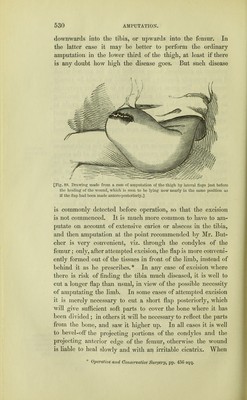
![downwards into the tibia, or upwards into the femur. In the latter case it may be better to perform the ordinary amputation in the lower third of the thigh, at least if there is any doubt how high the disease goes. But such disease [Fig. 8!>. Drawing made from a case of amputation of the thigh by lateral flaps just before the healing of the wound, which is seen to be lying now nearly in the same position as if the flap had been made antero-posteriorly.] is commonly detected before operation, so that the excision is not commenced. It is much more common to have to am- putate on account of extensive caries or abscess in the tibia, and then amputation at the point recommended by Mr. But- cher is very convenient, viz. through the condyles of the femur; only, after attempted excision, the flap is more conveni- ently formed out of the tissues in front of the limb, instead of behind it as he prescribes.* In any case of excision where there is risk of finding the tibia much diseased, it is well to cut a longer flap than usual, in view of the possible necessity of amputating the limb. In some cases of attempted excision it is merely necessary to cut a short flap posteriorly, which will give sufficient soft parts to cover the bone where it has been divided; in others it will be necessary to reflect the parts from the bone, and saw it higher up. In all cases it is well to bevel-off the projecting portions of the condyles and the projecting anterior edge of the femur, otherwise the wound is liable to heal slowly and with an irritable cicatrix. When * Operative and Conservative Surr/ery, pp. 456 sqq.](https://iiif.wellcomecollection.org/image/b20416325_0574.jp2/full/800%2C/0/default.jpg)