Calmet's Dictionary of the Holy Bible / by the late Mr. Charles Taylor, with the fragments incorporated. The whole condensed and arranged in alphabetical order; with numerous additions.
- Antoine Augustin Calmet
- Date:
- 1833
Licence: Public Domain Mark
Credit: Calmet's Dictionary of the Holy Bible / by the late Mr. Charles Taylor, with the fragments incorporated. The whole condensed and arranged in alphabetical order; with numerous additions. Source: Wellcome Collection.
761/996 page 739
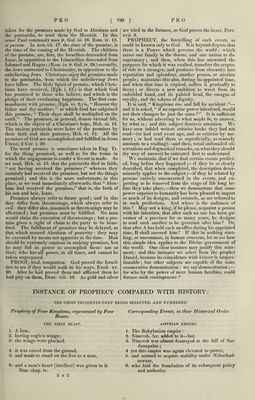
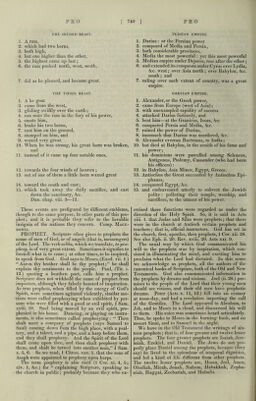
![taken for the promises made by God to Abraham and the patriarchs, to send them the Messiah. In this sense Paul commonly uses it, Gal. iii. 16. Rom. iv. 13. et passim. In Acts vii. 17. the .time of the promise, is the time of the coming’ of the Messiah. The children of the promise, are, first, the Israelites descended from Isaac, m opposition to the Ishmaelites descended from Ishmael and Hagar; (Rom. ix. 8. Gal. iv. 28.) secondly, the Jews converted to Christianity, in opposition to the unbelieving Jews. Christians enjoy the promises made to the patriarchs, from which the unbelieving Jews have fallen. The Holy Spirit of promise, which Chris- tians have received, (Eph. i. 13.) is that which God has promised to those who believe, and which is the pledge of their everlasting happiness. The first com- mandment with promise, (Eph. vi. 2.) is, “ Honour thy father and thy mother;” to which God has subjoined this promise, “ Their days shall be multiplied on the earth.” The promises, in general, denote eternal life, which is the object of a Christian’s hope, Heb. xi. 13. The ancient patriarchs were heirs of the promises by their faith and their patience, Heb. vi. 12. All the promises of God are accomplished and fulfilled in Jesus Christ, 2 Cor. i. 20. The word promise is sometimes taken in Eng. Tr. for the thing promised, as well as for the terms in which the engagement to confer a favour is made. So we read, Heb. xi. 13. that the patriarchs died in faith, “ not having received the promiseswhereas they certainly had received the promises, but not the things promised ; and this is the more unfortunate, in this lace, as we read immediately afterwards, that “ Abra- am had received the promises,” that is, the birth of his son and heir, Isaac. Promises always refer to future good; and in this they differ from threatenings, whicn always refer to evil: they differ also, inasmuch as threatenings may be alleviated ; but promises must be fulfilled. No man would claim the execution of threatenings ; but a pro- mise gives a right of claim to the party to be bene- fited. The fulfilment of promises may be delayed, as that which assured Abraham of posterity : they may be executed by means not apparent at the time. Man should be extremely cautious in making promises, lest he may fail in power to accomplish them: not so God; who has all power, at all times, and cannot be taken unprepared. PROOF, trial, temptation. God proved the Israel- ites to see if they would w alk in his ways, Exod. xx. 20. After he had proved them and afflicted them he had pity on them, Deut. viii. 16. As gold and silver are tried in the furnace, so God proves the heart, Prov. xvii. 3. PROPHECY, the foretelling of such events as could be known only to God. It is beyond dispute that there is a Power which governs the world ; which raises one family to the throne, and one nation to the supremacy; and then, when this has answered the purposes for which it was exalted, transfers the sceptre of rule to a stranger, and produces from obscurity into reputation and splendour, another person, or another people; maintains this also, during its appointed time, and when that time is expired, suffers it gradually to decay; or directs a new ambition to wrest from its enfeebled hand, and its palsied head, the ensigns of royalty, and the tokens of dignity. It is said, “ Kingdoms rise and fall by accident— and it is asked, “ if no superior power interfered, would not their changes be just the same ? ” It is sufficient for us, without adverting to what might be, to answer, by what is; and this subject deserves attention. We have seen infidel writers criticise books they had not read—(or had read years ago, and so criticise by me- mory ; or had read them so superficially, as scarcely amounts to a reading)—and then, retail unfounded ob- servations and dogmatical remarks, on what they should (by way of answer) be entreated first to understand. We maintain, that if we find certain events predict- ed, long before they happened ;—if they be so clearly described, that when completed, the description deter- minately applies to the subject;—if they be related by persons entirely unconcerned in the events, and ex- pecting to be removed from the stage of life long be- fore they take place,—then we demonstrate that some power superior to humanity has been pleased to impart so much of its designs, and counsels, as are referred to in such predictions. And where is the unfitness of this ? May not a king, if he please, acquaint a person with his intention, that after such an one has been go- vernor of a province for so many years, he designs to send such another to be governor after him ? Or, that after A has held such an office during his appointed time, B shall succeed him ? If this be nothing start- ling, or uncommon, in human concerns, let us see how this simple idea applies to the Divine government of the world. One edear instance may justify this state- ment : and this instance we select from the prophet Daniel, because its coincidence with history is unques- tionable ; but other subjects are capable of the same enumerative demonstration : we say demonstration ;— for who by the power of mere human faculties, could foresee such contingencies ? INSTANCE OF PROPHECY COMPARED WITH HISTORY: THE CHIEF INCIDENTS ONLY BEING SELECTED, AND NUMBERED. Prophecy of Four Kingdoms, represented by Four Beasts. THE FIRST BEAST. 1. A lion, 2. having eagle’s wings; 3. the wings were plucked. 4. it was raised from the ground, 5. and made to stand on the feet as a man, 6. and a man’s heart [intellect] was given to it. Dan. chap. iv. Corresponding Events, in their Historical Order. ASSYRIAN EMPIRE. 1. The Babylonian empire: 2. Nineveh, &c. added to it—but 3. Nineveh was almost destroyed at the fall of Sar- danapalus; 4 yet this empire was again elevated to power, 5. and seemed to acquire stability under Nebuchad- nezzar, 6. who laid the foundation of its subsequent policy and authority. 3 b 2](https://iiif.wellcomecollection.org/image/b28740324_0761.jp2/full/800%2C/0/default.jpg)