[Report 1955] / Medical Officer of Health, Rochester City and Port.
- Rochester (Kent, England). City and Port Authority.
- Date:
- 1955
Licence: Attribution-NonCommercial 4.0 International (CC BY-NC 4.0)
Credit: [Report 1955] / Medical Officer of Health, Rochester City and Port. Source: Wellcome Collection.
10/46
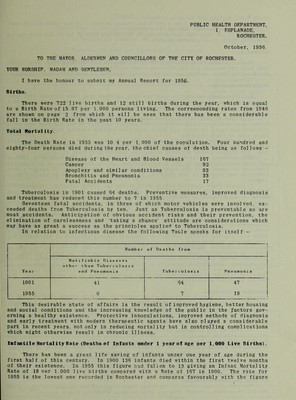
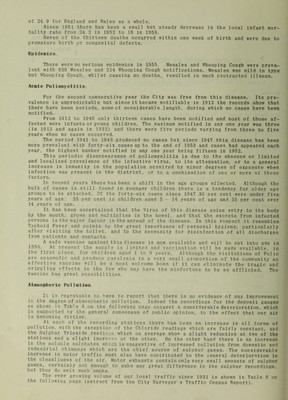
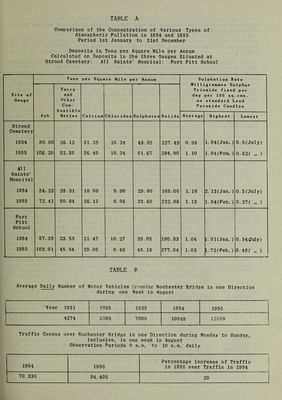
![ot 24 9 for England and Wales as a whole. Since 1951 there has been a small but steady decrease in the local infant mor¬ tality rate from 24 2 in 1952 to 18 in 1955 Seven of the thirteen deaths occurred within one week of birth and were due to premature birth or congenital defects. Epidemics. There were no serious epidemics in 1955 Measles and Whooping Cough were preva¬ lent with 638 Measles and 214 Whooping Cough notifications. Measles was mild in type but Whooping Cough, whilst causing no deaths, resulted in much protracted illness. Acute Poliomyelitis. For the second consecutive year the City was free from this disease. Its pre¬ valence is unpredictable but since it became notifiable in 1912 the records show that there have been periods, some of considerable length, during which no cases have been notified. From 1912 to 1940 only thirteen cases have been notified and most of those af¬ fected were infants or young children. The maximum notified in any one year was three (in 1913 and again in 1933) and there were five periods varying from three to five years when no cases occurred. The period 1941 to 1946 produced no cases but since 1947 this disease has been more prevalent with forty-six cases up to the end of 1953 and cases had appeared each year., the highest number notified in any one year being fifteen in 1952. This periodic disappearance of poliomyelitis is due to the absence or limited and localized prevalence of the infective virus, to its attenuation, or to a general increase in immunity in the population acnuired by minor degrees of exposure when infection was present in the district, or to a combination of one or more of these factors. In recent years there has been a shift in the age groups affected. Although the bulk of cases is still found in younger children there is a tendency for older age groups to be attacked. Of the forty-six cases since 1947 30 per cent were under five years of age 35 per cent in children aged 5 * 14 years of age and 35 per cent over 14 years of age. It has been ascertained that the Virus of this disease gains entry to the body by the mouth, grows and multiplies in the bowel, and that the excreta from infected persons is the major factor in the spread of the disease. In this respect it resembles Typhoid Fever and points to the great importance of personal hygiene, particularly after visiting the toilet, and to the necessity for disinfection of all discharges from patients and contacts. A safe vaccine against this disease is now available and will be put into uSe in 1956. At present the supply is limited and vaccination will be made available, in the first place, for children aged 1 to 9 years. Although the visitations of Polio are spasmodic and produce paralysis in a very small proportion of the community an effective vaccine will be a most welcome boon if it can eliminate the tragic and crippling effects in the few who may have the misfortune to be so afflicted. The vaccine has great possibilities. Atmospheric Pollution It is regretoble to have to report that there is no evidence of any improvement in the degree of atmospheric pollution. Indeed the recordings for the deposit gauges as shown in Tab1 e A on the following page suggest a considerable deterioration, which is supported by the general consensus of public opinion, to the effect that our air is becoming dirtier. At each of the recording stations there has been an increase in all forms of pollution, with the exception of the Chloride readings which are fairly constant, and the Sulphur Trioxide readin s which on average show a slight reduction at two of the stations and a slight increise at the other. On the other hand there is an increase in the soluble sulphates which is suggestive of increased pollution from domestic and industrial chimneys which are the chief source of sulphur gases. The considerable increase in motor traffic must also have contributed to the general deterioration in the cleanliness of the air. Motor exhausts contain on] y very small amounts of sulphur gases, certainly not enough to make any great difference in the sulphur recordings, but they do emit much smoke. The ever growing volume of our local traffic since 1931 is shown in Table R on the following page (extract from the City Surveyor’s Traffic Census Report).](https://iiif.wellcomecollection.org/image/b30039058_0012.jp2/full/800%2C/0/default.jpg)