[Report 1955] / Medical Officer of Health, Rochester City and Port.
- Rochester (Kent, England). City and Port Authority.
- Date:
- 1955
Licence: Attribution-NonCommercial 4.0 International (CC BY-NC 4.0)
Credit: [Report 1955] / Medical Officer of Health, Rochester City and Port. Source: Wellcome Collection.
12/46
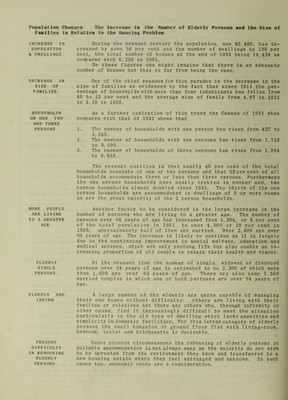
![Population Changes The Increase in the Number of Elderly Persons and the Size of Families in Relation to the Housing Problem. INCREASE IN POPULATION h DWELLINGS DECREASE IN SIZE OF FAMILIES HOUSFHOLDS OF ONE TWO AND THREE PERSONS MORE PEOPLE ARE LIVING TO A GREATER AGE ELDERLY SINGLE PERSONS ELDERLY AND INFIRM PRESENT DIFFICULTY IN REHOUSING ELDERLY PERSONS During the present century the population, now 45,480, has in¬ creased by some 50 per cent and the number of dwellings by 130 per cent, the total number of houses at the end of 1955 being 14,424 as compared with 5,236 in 1901. On these figures one might imagine that there is an adequate number of houses but this is far from being the case. One of the chief reasons for this paradox is the decrease in the size of families as evidenced by the fact that since 1911 the per¬ centage of households with more than four inhabitants has fallen from 40 to 15 per cent and the average size of family from 4.97 in 1911 to 3.15 in 1955. As a further indication of this trend the Census of 1951 when compared with that of 1931 shows that 1. The number of households with one person has risen from 427 to 1. 245. 2. The number of households with two persons has risen from 1,718 to 3,699. 3. The number of households of three persons has risen from 1,954 to 3,483. The present position is that nearly 40 per cent of the total households consists of one or two persons and that 53 per cent of all households accommodate three or less than three persons. Furthermore the one person households have nearly trebled in number and, two person households almost doubled since 1931. Two thirds of the one person households are accommodated in dwellings of 5 or more rooms as are the great majority of the 2 person households. Another factor to be considered is the large increase in the number of persons who are living to a greater age. The number of persons over 64 years of age has increased from 1,384, or 4 per cent of the total population in 1901, to over 4,500 or 10 per cent in 1955, approximately half of them are married. Over 2,800 are over 69 years of age. The increase is likely to continue as it is largely due to the continuing improvement in social welfare, education and medical science, which not only prolong life but also enable an in¬ creasing proportion of old people to retain their health and vigour. At the present time the number of single, widowed or divorced persons over 64 years of age is estimated to be 2,300 of which more than 1,600 are over 59 years of age. There are also some 1,500 married couples in which one or both partners are over 64 years of age. A large number of the elderly are quite capable of managing their own homes without difficulty others are living with their families or relatives but there are others who, through infirmity or other cause, find it increasingly difficult to meet the situation particularly in the old type of dwelling which 1 acksamenities and simp]icity in domestic facilities. For this latter category of elderly persons the small bungalow or ground floor flat with living-room, bedroom, toilet and kitchenette is desirable. Under present circumstances the rehousing of elderly persons in suitable accommodation is not always easy as the majority do not wish to be uprooted from the environment they know and transferred to a new housing estate where they feel estranged and unknown. In such cases too, economic rents are a consideration.](https://iiif.wellcomecollection.org/image/b30039058_0014.jp2/full/800%2C/0/default.jpg)