[Report 1923] / Medical Officer of Health, Morpeth R.D.C.
- Morpeth (England). Rural District Council.
- Date:
- 1923
Licence: Attribution 4.0 International (CC BY 4.0)
Credit: [Report 1923] / Medical Officer of Health, Morpeth R.D.C. Source: Wellcome Collection.
5/18 page 5
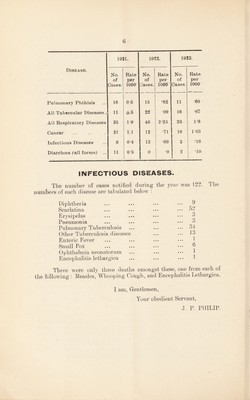
![have been condemned at Stobswood Wood Row, at. Widdrington south Broomhill and Stone Row, North Broomhill. 2. Improved Drainage. . This is still held up, but a new system at Pegswood Colliery is on the way, and will, I trust, soon be started l ie large system for Stobswood, Widdrington, Broomhill and Chevmgton is still waiting a Government grant. At Lvnemouth the new system should be very satisfactory, as it is carried well out to sea. 3. The need for a general Fever Hospital has already been mentioned. 4. C olliery Roads.—I he new bye-laws make it necessary that the roads should be well made. The paving of yards and making good roads has improved many of the old houses which are more easily kept clean. Ihe schools must also benefit by this. 5. If the Government will not give grants for Baby Welfare, I would recommend local centres to establish committees and form centres oi their own, raising funds by subscriptions. I am certain it would repay the trouble and expense. The reduction in infantile deaths is, I am sure, due to the education of mothers. But if I may sug¬ gest it, oreast feeding should be encouraged more than it is. Un- i i jei;e 1S, ve,T food reason for using any other food, every child should be brought up on the breast for the first seven or eio-ht months. ° VITAL STATISTICS. f 1 • ?W{ ra'1'E — The number of births during the year was 364 of which 176 were males and 188 females. There were 15 illegitimate children. Ihe birth rate per 1000 is therefore 19‘9, although this is still much below the average it is better by T9 than the previous year. DEATH RATE. The number of deaths was 189, exactly the same number as m 19'22, of these 94 were males and 95 females. This is calculated for residents, whether in the district or outside. The death late per 1000 residents is therefore 10*3. Only deaths of residents aie now calculated as all deaths m public institutions such as the asylums or hospitals etc., are allocated to their respective districts Tiere were / I deaths of non residents in the Asylum, so, if this is in- chicled there were 260 deaths m the district, giving a rate of 13 4 per INFANIILE DEATH RATE.—Although the births were more 111 ]f'1 {\n wl}icL 01]]y 329 occurred^, yet the 364 births V >• f t ierC1 below the average, yet the death rate in the first 'bin e Thief11, lle WaSr m*?h ,loTr* 0niy 21 deaths occurred in that time. 1 his gives an infantile death rate of 57‘6 per 1000 children born. most imirnrmm^^DISEASES.—In the following I have tabulated the most impoitant diseases with the rate per 1000 of the population :](https://iiif.wellcomecollection.org/image/b2980386x_0005.jp2/full/800%2C/0/default.jpg)