The great crime of the nineteenth century : why it is committed? Who are the criminals? How shall they be detected? How shall they be punished? / by Edwin M. Hale, M.D.
- Edwin Moses Hale
- Date:
- 1867
Licence: Public Domain Mark
Credit: The great crime of the nineteenth century : why it is committed? Who are the criminals? How shall they be detected? How shall they be punished? / by Edwin M. Hale, M.D. Source: Wellcome Collection.
Provider: This material has been provided by the Francis A. Countway Library of Medicine, through the Medical Heritage Library. The original may be consulted at the Francis A. Countway Library of Medicine, Harvard Medical School.
22/56 page 14
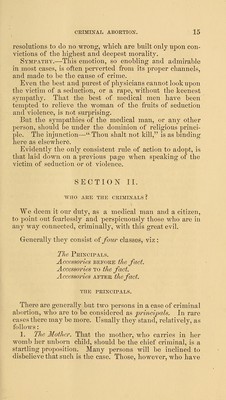
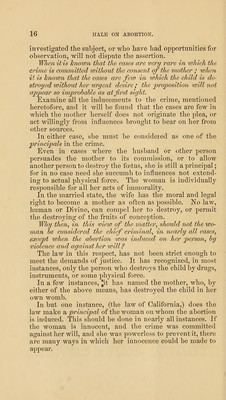
![able classes, persons of wealtli and influence, and often of culture and refinement, and even of high ^religious standing! To show that I am not mistating the prevalence of abor- tion in the higher classes, I quote from the W. W. Chris- tian Advocate, March 13, 1867. Plalf of these, (women who are guilty of child-murder,) are members of Christ's church. The Protestant church, is to-day, blackly stained with this crime of child-murder. To prove the correctness of these statements, I also quote from Dr. Stewart, of Detroit: But few of either sex enter the marital relation without full information as to the ways and means of * * de- stroying the legitimate results of matrimony. * * Among married persons, so extensive has this practice be- come, that people of high repute not only commit this crime, but do not shun to speak boastingly among their intimates, of the deed and the means of accomplishing it. (Pp. Y, 8.) And also from the letter of Dr. Kyle, of Xenia, Ohio, quoted by Dr. Reamy : The abortions occur most frequently among those who are known as the better class j among church members, and those generally who pretend to be most polite, virtuous, moral, and religious. A venal press—a demoralized clergy, the prevalence of [medical] charlatanism * ' * are the principal causes of the feariul increase of the abomin- able crime of criminal abortions. But these gentlemen omit or neglect to mention a fact of which they must have been cognizant, namely: that the honorablejphgsician luho refuses to accede to the wishes of such patrons, is often obliged to see their j[>atronage trans- ferred to other and less scrujpulous persons. My colleagues will bear me out in the assertion, that such transfer of j)atronage is a growing evil which needs to be abated by some influence—moral, religious, or legal—■ which is not now in operation. While we admit that no physician of standing in society, whose f)rinciples are well grounded, and whose ideas of crime are unvarying, can ever be tempted or influenced by sucli inducements, I do not hesitate to assert the possible immoral influence of such solicitations, entreaties, and l)ribes—upon the conscience of a young ph3''sician, poor, perhaps in need of patronage, and who has not those firm](https://iiif.wellcomecollection.org/image/b21056377_0022.jp2/full/800%2C/0/default.jpg)