An introduction to the study of human anatomy (Volume 1).
- James Paxton
- Date:
- 1837-1840
Licence: Public Domain Mark
Credit: An introduction to the study of human anatomy (Volume 1). Source: Wellcome Collection.
Provider: This material has been provided by the National Library of Medicine (U.S.), through the Medical Heritage Library. The original may be consulted at the National Library of Medicine (U.S.)
82/466
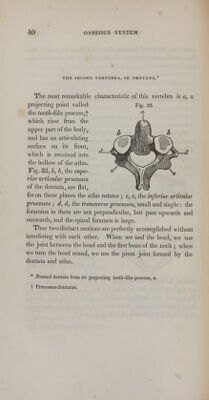
![THE SECOND VERTEBRA, OR DENTATA. </-,• I—<? The most remarkable characteristic of this vertebra is a, a projecting point called Fig. 32. the tooth-like process,-]- which rises from the upper part of the body, and has an articulating surface on its front, which is received into the hollow of the atlas. Fig. 32, b, b, the supe- rior articular processes of the dentata, are flat, for on these planes the atlas rotates ; c, c, the inferior articular processes ; d, d, the transverse processes, small and single : the foramina in them are not perpendicular, but pass upwards and outwards, and the spinal foramen is large. Thus two distinct motions are perfectly accomplished without interfering with each other. When we nod the head, we use the joint between the head and the first bone of the neck; when we turn the head round, we use the pivot joint formed by the dentata and atlas. Named dentata from its projecting tooth-like process, a. t Processus dentatus.](https://iiif.wellcomecollection.org/image/b21146305_0082.jp2/full/800%2C/0/default.jpg)