A dictionary of practical surgery: comprehending all the most interesting improvements, from the earliest times down to the present period ... forming a catalogue of surgical literature arranged according to subjects / by Samuel Cooper.
- Samuel Cooper
- Date:
- 1838
Licence: Public Domain Mark
Credit: A dictionary of practical surgery: comprehending all the most interesting improvements, from the earliest times down to the present period ... forming a catalogue of surgical literature arranged according to subjects / by Samuel Cooper. Source: Wellcome Collection.
13/794 (page 7)
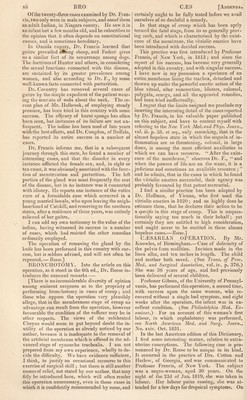
![AMPUTATION. The following notice I find in Reese’s American edition of this Dictionary. The proposed operation, I apprehend, will be objected to, as far rnore painful and tedious than the flap-amputations, commonly performed at University College Hospital: — [A mode of amputating the thigh with two flaps (observes Dr. Reese) was proposed a few years since by Professor J. B. Davidge, of the Univer- sity of Maryland, which combines several impor- tant advantages. The first incision is made with the large knife on the outside and inside of the thigh through the integument, so as to surround the limb, with the exception of an inch or more in the centre above- and below. The surgeon having calculated the size of the flaps required, which are to be as long as the semi-rliameter of the limb, makes with a scalpel a second and third incision through the skin, in form of the letter V, commenc- ing above the centre of the space left vacant on the superior and inferior surface, and con- tinued until its diverging extremities reach the ends of the semicircular cuts first mentioned. The flaps of integument are then dissected back until they equal in length a little more than the semi-diameter of the limb, to allow for the retrac- tion that, may occur. A circular incision is then made through the muscles down to the bone with the large knife. The bone is then denuded for an inch or two, the retractor employed, and the bone sawn off at the edge of the divided flesh. The arteries are then secured, the muscles drawn down, the ligatures so arranged as to come out of the superior and inferior angles of the wound, and the flaps are brought together and kept in place by adhesive straps, supported by a cross bandage, roller, &c. By this amputation the bone is cut off* an inch or more within the ac- tual face of the stump, and the flaps of integu- ment having the angle cut out above and be- low, do not present that unnecessary and incon- venient lump or puckering, formed at the angles after the common circular amputation. I have seen this operation performed by Dr. Davidge and others, with singular success. The stump heals by the first intention, without any of the de- lays which are often encountered with the common flap-operation ; and I prefer it for the arm as well as the thigh, unless the limb be much emaciated. Reese.] In flap-amputations of the leg, it appears to me, that the anterior flap of integuments should bq made longer, and the posterior flap of the in- teguments and muscles of the calf, about one means, the front of the tibia will be better covered, and the frequency of exfoliation diminished; while there will also be the advantage of the sur- face of the wound being considerably lessened below, where matter is disposed to form and lodge. In the United States, amputation of the upper jaw was first performed by Dr. David L. Rogers, of New York. (See Osteosarcoma.) Ampu- tation, or exsection of the clavicle, was there per- formed for the first time by Dr. Mott, in 1829. In the twenty-first volume of the Med. Chir. Trans. are the particulars of a similar operation executed by Mr. Travers. Other cases 1 have noticed in the article Bones, excision of. In Mr Travers’s case, the operation was performed on account of a tumour of the clavicle. “ A crucial incision was made through the integument and platysma my- oides, one limb of which was nearly in the line of the clavicle, and the other at right angles ; and the flaps and fascial coverings successively dissected down to the external basis of the tumour. The pectoralis and deltoid muscles were then carefully detached from their clavicular origin, avoiding the cephalic veins, and the fibres of the trapezius and cleido-mastoid muscles divided on a director. One considerable vessel, in the situation of the transversalis humeri, required a prompt ligature. The circumference of the tumour was now well defined, though it was found to be firmly imbedded, and adherent on its posterior aspect. Disarticula- tion of the scapular extremity of the bone was next effected without difficulty ; and the mobility, thus communicated to the mass, facilitated the completion of the operation. A director was now worked beneath the bone, as near to the sternal articulation as was practicable, and, with a pair of strong bone nippers, thus introduced, it was com- pletely and clearly divided. The subclavius muscle, and a part of the rhomboid ligament, were now detached from the tumour, and the mass being well raised by an assistant, while the edges of the wound were kept wide apart by metallic retrac- tors, the cervical prolongations of the tumour were separated from their remaining connections by a few touches of the scalpel, without injury to the subclavian vessels.” The loss of blood did not exceed twelve ounces. The case terminated so favourably that there was scarcely any falling forward of the shoulder, nor any restriction of the motions of the arm. The young gentleman ele- vates it perpendicularly over his head, extends it horizontally, carries and rotates it behind the trunk, and performs the same extent and variety of circumduction, and with equal promptitude and](https://iiif.wellcomecollection.org/image/b29339674_0013.jp2/full/800%2C/0/default.jpg)