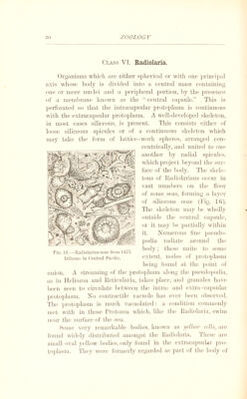
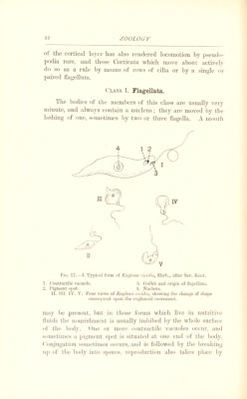
Zoology of the invertebrata : a text-book for students / by Arthur E. Shipley.
- Arthur Shipley
- Date:
- 1893
Licence: Public Domain Mark
Credit: Zoology of the invertebrata : a text-book for students / by Arthur E. Shipley. Source: Wellcome Collection.
36/474 page 24
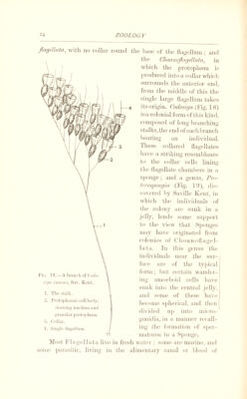
![Jlagcllata, with no collar round the base of the flagellum; and the Choanoflagellata, in which the protoplasm is produced into a collar which surrounds the anterior end, from the middle of this the single large flagellum takes its origin. Codosiga (Fig. 18) is a colonial form of this kind, composed of long branching stalks, the end of each branch bearing an individual. These collared flagellates have a striking resemblance to the collar cells lining the flagellate chambers in a sponge; and a genus, Pra¬ ter ospongia (Fig. 19), dis¬ covered by Saville Kent, in which the individuals of the colony are sunk in a jelly, lends some support to the view that Sponges may have originated from colonies of Choanoflagel¬ lata. In this genus the individuals near the sur¬ face are of the typical« form; but certain wander¬ ing amoeboid cells have sunk into the central jelly, and some of these have 1 become spherical, and then divided up into micro- gonidia, in a manner recall¬ ing the formation of sper¬ matozoa in a Sponge. Most Flagellata live in fresh water : some are marine, and some parasitic, living in the alimentary canal or blood of Fig. 18.—A branch of t'oclo- sif/a cymosa, Sav. Kent. 1. The stalk. 2. Protoplasmic cell body, showing nucleus and granular proto]ilasni. 8. Collar.](https://iiif.wellcomecollection.org/image/b29316194_0036.jp2/full/800%2C/0/default.jpg)