Federal technology transfer and the Human Genome Project / Congress of the United States, Office of Technology Assessment.
- United States Office of Technology Assessment
- Date:
- [1995]
Licence: Public Domain Mark
Credit: Federal technology transfer and the Human Genome Project / Congress of the United States, Office of Technology Assessment. Source: Wellcome Collection.
23/132 page 13
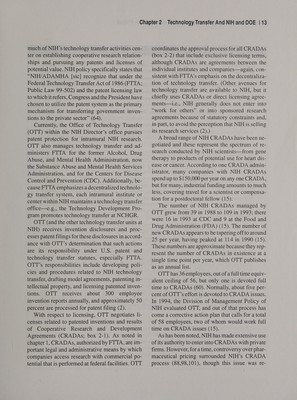
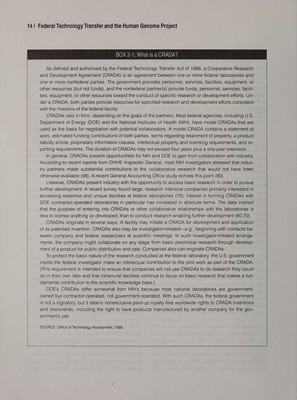
![much of NIH’s technology transfer activities cen- ter on establishing cooperative research relation- ships and pursuing any patents and licenses of potential value. NIH policy specifically states that “NIH/ADAMHA [sic] recognize that under the Federal Technology Transfer Act of 1986 (FTTA; Public Law 99-502) and the patent licensing law to which it refers, Congress and the President have chosen to utilize the patent system as the primary mechanism for transferring government inven- tions to the private sector” (64). Currently, the Office of Technology Transfer (OTT) within the NIH Director’s office pursues patent protection for intramural NIH research. OTT also manages technology transfer and ad- ministers FTTA for the former Alcohol, Drug Abuse, and Mental Health Administration, now the Substance Abuse and Mental Health Services Administration, and for the Centers for Disease Control and Prevention (CDC). Additionally, be- cause FTTA emphasizes a decentralized technolo- gy transfer system, each intramural institute or center within NIH maintains a technology transfer office—e.g., the Technology Development Pro- gram promotes technology transfer at NCHGR. OTT (and the other technology transfer units at NIH) receives invention disclosures and proc- esses patent filings for these disclosures in accord- ance with OTT’s determination that such actions are its responsibility under U.S. patent and technology transfer statutes, especially FTTA. OTT’s responsibilities include developing poli- cies and procedures related to NIH technology transfer, drafting model agreements, patenting in- tellectual property, and licensing patented inven- tions. OTT receives about 300 employee invention reports annually, and approximately 50 percent are processed for patent filing (2). With respect to licensing, OTT negotiates li- censes related to patented inventions and results of Cooperative Research and Development Agreements (CRADAs; box 2-1). As noted in chapter 1, CRADAs, authorized by FTTA, are im- portant legal and administrative means by which companies access research with commercial po- tential that is performed at federal facilities. OTT coordinates the approval process for all CRADAs (box 2-2) that include exclusive licensing terms, although CRADAs are agreements between the individual institutes and companies—again, con- sistent with FTTA’s emphasis on the decentraliza- tion of technology transfer. (Other avenues for technology transfer are available to NIH, but it chiefly uses CRADAs or direct licensing agree- ments—1i.e., NIH generally does not enter into “work for others” or into sponsored research agreements because of statutory constraints and, in part, to avoid the perception that NIH is selling its research services (2).) A broad range of NIH CRADAs have been ne- gotiated and these represent the spectrum of re- search conducted by NIH scientists—from gene therapy to products of potential use for heart dis- ease or cancer. According to one CRADA admin- istrator, many companies with NIH CRADAs spend up to $150,000 per year on any one CRADA, but for many, industrial funding amounts to much less, covering travel for a scientist or compensa- tion for a postdoctoral fellow (15). The number of NIH CRADAs managed by OTT grew from 39 in 1988 to 109 in 1993; there were 16 in 1993 at CDC and 9 at the Food and Drug Administration (FDA) (15). The number of new CRADAs appears to be tapering off to around 25 per year, having peaked at 114 in 1990 (15). These numbers are approximate because they rep- resent the number of CRADAs in existence at a single time point per year, which OTT publishes as an annual list. OTT has 36 employees, out of a full time equiv- alent ceiling of 56, but only one is devoted full time to CRADAs (60). Normally, about five per- cent of OTT’s effort is devoted to CRADA issues. In 1994, the Division of Management Policy of NIH evaluated OTT, and out of that process has come a corrective action plan that calls for a total of 58 employees, two of whom would work full time on CRADA issues (15). As has been noted, NIH has made extensive use of its authority to enter into CRADAs with private firms. However, for a time, controversy over phar- maceutical pricing surrounded NIH’s CRADA process (88,98,101), though this issue was re-](https://iiif.wellcomecollection.org/image/b32222142_0023.jp2/full/800%2C/0/default.jpg)