Federal technology transfer and the Human Genome Project / Congress of the United States, Office of Technology Assessment.
- United States Office of Technology Assessment
- Date:
- [1995]
Licence: Public Domain Mark
Credit: Federal technology transfer and the Human Genome Project / Congress of the United States, Office of Technology Assessment. Source: Wellcome Collection.
37/132 page 27
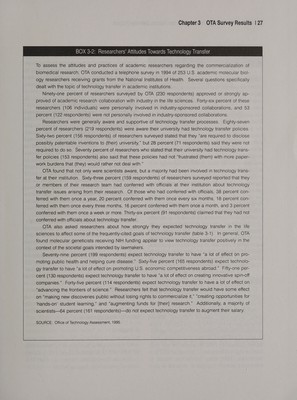
![Chapter 3 OTA Survey Results | 27 BOX 3-2: Researchers’ Attitudes Towards Technology Transfer To assess the attitudes and practices of academic researchers regarding the commercialization of biomedical research, OTA conducted a telephone survey in 1994 of 253 U.S. academic molecular biol- ogy researchers receiving grants from the National Institutes of Health. Several questions specifically dealt with the topic of technology transfer in academic institutions. Ninety-one percent of researchers surveyed by OTA (230 respondents) approved or strongly ap- proved of academic research collaboration with industry in the life sciences. Forty-six percent of these researchers (106 individuals) were personally involved in industry-sponsored collaborations, and 53 percent (122 respondents) were not personally involved in industry-sponsored collaborations. Researchers were generally aware and supportive of technology transfer processes. Eighty-seven percent of researchers (219 respondents) were aware their university had technology transfer policies. Sixty-two percent (156 respondents) of researchers surveyed stated that they “are required to disclose possibly patentable inventions to (their) university,” but 28 percent (71 respondents) said they were not required to do so. Seventy percent of researchers who stated that their university had technology trans- fer policies (153 respondents) also said that these policies had not “frustrated (them) with more paper- work burdens that (they) would rather not deal with.” OTA found that not only were scientists aware, but a majority had been involved in technology trans- fer at their institution. Sixty-three percent (159 respondents) of researchers surveyed reported that they or members of their research team had conferred with officials at their institution about technology transfer issues arising from their research. Of those who had conferred with officials, 38 percent con- ferred with them once a year, 20 percent conferred with them once every six months, 18 percent con- ferred with them once every three months, 16 percent conferred with them once a month, and 3 percent conferred with them once a week or more. Thirty-six percent (91 respondents) claimed that they had not conferred with officials about technology transfer. OTA also asked researchers about how strongly they expected technology transfer in the life sciences to affect some of the frequently-cited goals of technology transfer (table 3-1). In general, OTA found molecular geneticists receiving NIH funding appear to view technology transfer positively in the context of the societal goals intended by lawmakers. Seventy-nine percent (199 respondents) expect technology transfer to have “a lot of effect on pro- moting public health and helping cure disease.” Sixty-five percent (165 respondents) expect technolo- gy transfer to have “a lot of effect on promoting U.S. economic competitiveness abroad.” Fifty-one per- cent (130 respondents) expect technology transfer to have “a lot of effect on creating innovative spin-off companies.” Forty-five percent (114 respondents) expect technology transfer to have a lot of effect on “advancing the frontiers of science.” Researchers felt that technology transfer would have some effect on “making new discoveries public without losing rights to commercialize it, “creating opportunities for ‘hands-on’ student learning,” and “augmenting funds for [their] research.” Additionally, a majority of scientists—64 percent (161 respondents)—do not expect technology transfer to augment their salary. SOURCE: Office of Technology Assessment, 1995.](https://iiif.wellcomecollection.org/image/b32222142_0037.jp2/full/800%2C/0/default.jpg)