Report on small-pox in Calcutta, 1833-34 -- 1837-38 -- 1843-44, and vaccination in Bengal, from 1827 to 1844 / by Duncan Stewart.
- Stewart, Duncan, 1804-1875
- Date:
- 1844
Licence: Public Domain Mark
Credit: Report on small-pox in Calcutta, 1833-34 -- 1837-38 -- 1843-44, and vaccination in Bengal, from 1827 to 1844 / by Duncan Stewart. Source: Wellcome Collection.
Provider: This material has been provided by London School of Hygiene & Tropical Medicine Library & Archives Service. The original may be consulted at London School of Hygiene & Tropical Medicine Library & Archives Service.
304/316
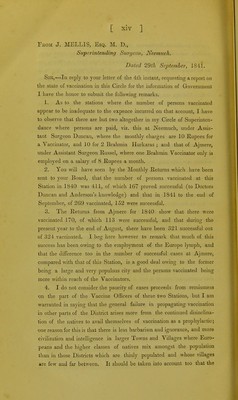
![[ ^ ] PxiOM J. MELLIS, Esq. M. D., Superintending Surgeon, Neemuch. Dated 29th September, 18-11. Sir,^—In reply to your letter of the 4th instant, requesting a report on the state of vaccination in this Circle for the information of Government I have the honor to submit the following remarks. 1. As to the stations where the number of persons vaccinated appear to be inadequate to the expence incurred on that account, I have to observe that there are but two altogether in my Circle of Superinten- dance where persons are paid, viz. this at Neemuch, under Assis- tant Surgeon Duncan, where the monthly charges are 10 Rupees for a Vaccinator, and 10 for 2 Brahmin Hurkaras ; and that of Ajmere, under Assistant Surgeon Russel, where one Brahmin Vaccinator only is employed on a salary of 8 Rupees a month. 2. You will have seen by the Monthly Returns which have been sent to your Board, that the number of persons vaccinated at this Station in 1840 was 411, of which 167 proved successful (to Doctors Duncan and Anderson's knowledge) and that in 1841 to the end of September, of 269 vaccinated, 152 were successful. 3. The Returns from Ajmere for 1840 show that there were vaccinated 170, of which 113 were successful, and that during the present year to the end of August, there have been 321 successful out of 324 vaccinated. I beg here however to remark that much of this success has been owing to the employment of the Europe lymph, and that the difference too in the number of successful cases at Ajmere, compared with that of this Station, is a good deal owing to the former being a large and very populous city and the persons vaccinated being more within reach of the Vaccinators. 4. I do not consider the paucity of cases proceeds from remissness on the part of the Vaccine Officers of these two Stations, but I am warranted in saying that the general failure in j'ropagating vaccination in other parts of the District arises more from the continued disinclina- tion of the natives to avail themselves of vaccination as a prophylactic; one reason for this is that there is less barbarism and ignorance, and more civilization and intelligence in larger Towns and Villages where Euro- peans and the higher classes of natives mix amongst the population than in those Districts which are thinly populated and whose villages are few and far between. It should be taken into account too that the](https://iiif.wellcomecollection.org/image/b21355150_0304.jp2/full/800%2C/0/default.jpg)