The constituents of hops / by Frederick B. Power, Frank Tutin and Harold Rogerson.
- Frederick Belding Power
- Date:
- [1913]
Licence: In copyright
Credit: The constituents of hops / by Frederick B. Power, Frank Tutin and Harold Rogerson. Source: Wellcome Collection.
Provider: This material has been provided by The Royal College of Surgeons of England. The original may be consulted at The Royal College of Surgeons of England.
13/28 (page 1277)
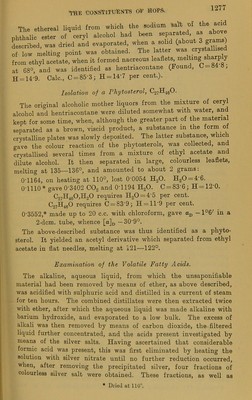
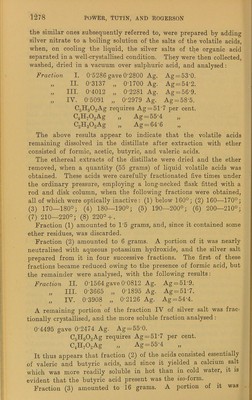
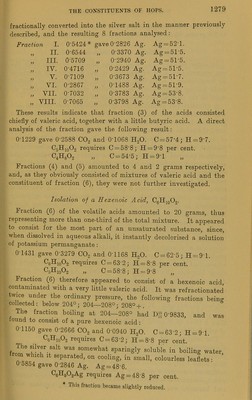
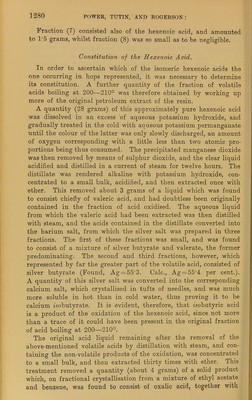
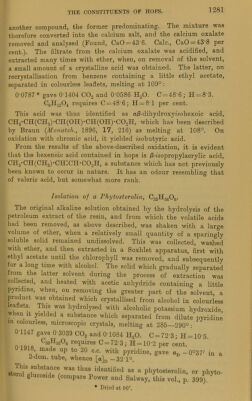
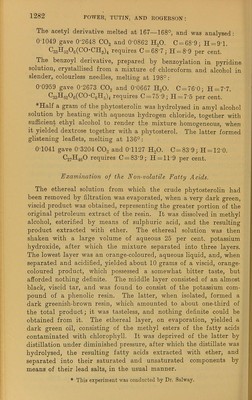
![T'HE constituents OE EOES. The ethereal liquid from which the sodium ^alt 'of the acid phthalic ester of ceryl alcohol had been ^ described, was dried and evaporated, when a solid (about 3 g™) of- low melting point was obtained. The latter was crystallised from ethyl acetate, when it formed nacreous leaflets melting sharply at 68°, and was identified as hentriacontane (Found, , H = 14-9. Calc., C = 85-3; H = l4-7 per cent.). Isolation of a Phytosterol, C27H^gO. The original alcoholic mother liquors from the mixture of ceryl alcohol and hentriacontane were diluted somewhat with water, and kept for some time, when, although the greater part of the material separated as a brown, viscid product, a substance in the form of crystalline plates was slowly deposited. The latter substance, which gave the colour reaction of the phytosterols, was collected, and crystallised several times from a mixture of ethyl acetate and dilute alcohol. It then separated in large, colourless leaflets, melting at 135—136°, and amounted to about 2 grams: 0'1164, on heating at 110°, lost 0'0054 H2O. H20 = 4'6. OTllO* gave 0'3402 CO2 and 0'1194 H2O. C = 83'6; H = 12'0. C27H460,H20 requires H20 = 4'5 per cent. C,7H4gO requires C = 83'9; H = 11‘9 per cent. 0-3552,* made up to 20 c.c. with chloroform, gave Ou -1°6' in a 2-dcm. tube, whence [a]p — 30'9°. The above-described substance was thus identified as a phyto- sterol. It yielded an acetyl derivative which separated from ethyl acetate in flat needles, melting at 121—122°. Examination of the Volatile Fatty Acids. The alkaline, aqueous liquid, from which the unsaponifiable material had been removed by means of ether, as above described, was acidified with sulphuric acid and distilled in a current of steam for ten hours. The combined distillates were then extracted twice with ether, after which the aqueous liquid was made alkaline with barium hydroxide, and evaporated to a low bulk. The excess of alkali was then removed by means of carbon dioxide, the filtered liquid further concentrated, and the acids present investigated by means of the silver salts. Having ascertained that considerable formic acid was present, this was first eliminated by heating the solution with silver nitrate until no further reduction occurred, when, after removing the precipitated silver, four fractions of colourless silver salt were obtained. These fractions, as well as](https://iiif.wellcomecollection.org/image/b22443733_0015.jp2/full/800%2C/0/default.jpg)