Recent experiences of the United States Army with regard to sanitation of yellow fever in the tropics / by W.C. Gorgas.
- William Crawford Gorgas
- Date:
- 1903
Licence: Public Domain Mark
Credit: Recent experiences of the United States Army with regard to sanitation of yellow fever in the tropics / by W.C. Gorgas. Source: Wellcome Collection.
7/10 page 51
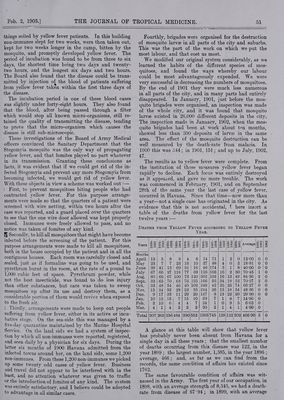
![things soiled by yellow fever patients. In this building non-immunes slept for two weeks, were then taken out, kept for two weeks longer in the camp, bitten by the mosquito, and promptly developed yellow fever. The period of incubation was found to be from three to six days, the shortest time being two days and twenty- two hours, and the longest six days and two hours. The Board also found that the disease could be trans- mitted by injection of the blood of patients suffering from yellow fever taken within the first three days of the disease. The incubation period in one of these blood cases was slightly under forty-eight hours. They also found that the blood, after being passed through a filter which would stop all known micro-organisms, still re- tained the quality of transmitting the disease, tending to prove that the micro-organism which causes the disease is still sub-microscopic. . These investigations of the Board of Army Medical officers convinced the Sanitary Department that the Stegomyia mosquito was the only way of propagating yellow fever, and that fomites played no part whatever in its transmission. Granting these conclusions as facts, it was evident that 1f we could get rid of the in- fected Stegomyia and prevent any more Stegomyia from becoming infected, we would get rid of yellow fever. With these objects in view a scheme was worked out :— | First, to prevent mosquitoes biting people who had contracted yellow fever. For this purpose arrange- ments were made so that the quarters of a patient were screened with wire netting, within two hours after the case was reported, and a guard placed over the quarters to see that the one wire door allowed was kept properly closed. Immunes were freely allowed to pass, and no notice was taken of fomites of any kind. & Secondly, to kill all mosquitoes that might have become infected before the screening of the patient. For this purpose arrangements were made to kill all mosquitoes, both in the house occupied by the patient and in all the contiguous houses. Hach room was carefully closed and sealed, just as if formaline was going to be used, and pyrethrum burnt in the room, at the rate of a pound to 1,000 cubic feet of space. Pyrethrum powder, while not the best insecticide, was found to do less injury than other substances, but care was taken to sweep mosquitoes up after its use and destroy them, as a considerable portion of them would revive when exposed to the fresh air. . Thirdly, arrangements were made to keep out people suffering from yellow fever, either in its active or incu- bative stage. On the sea-side this was managed by a five-day quarantine maintained by the Marine Hospital Service. On the land side we had a system of inspec- tion by which all non-immunes were reported, registered, and seen daily by a physician for six days. During the latter six months of 1900 Havana admitted from the infected towns around her, on the land side, some 1,200 non-immunes. From these 1,200 non-immunes we picked up some twenty odd cases of yellow fever. Business and travel did not appear to be interfered with in the least, and no attention whatever was given to traffic or the introduction of fomites of any kind. The system was entirely satisfactory, and I believe could be adopted to advantage in all similar cases. Fourthly, brigades were organised for the destruction of mosquito larve in all parts of the city and suburbs. This was the part of the work on which we put the most labour, and that cost us most. We modified our original system considerably, as we learned the habits of the different species of mos- quitoes, and found the ways whereby our labour could be most advantageously expended. We were very successful in decreasing the numbers of mosquitoes. By the end of 1901 they were much less numerous in all parts of the city, and in many parts had entirely disappeared. In January, 1901, just before the mos- quito brigades were organised, an inspection was made of the whole city, and it was found that mosquito larve existed in 26,000 different deposits in the city. The inspection made in January, 1902, when the mos- quito brigades had been at work about ten months, showed less than 300 deposits of larve in the same area. The effect of the mosquito destruction can be well measured by the death-rate from malaria. In 1900 this was 544; in 1901, 151; and up to July, 1902, 47, The results as to yellow fever were complete. From the institution of these measures yellow fever began rapidly to decline. Each focus was entirely destroyed as it appeared, and gave no more trouble. The work was commenced in February, 1901, and on September 28th of the same year the last case of yellow fever. occurred in Havana. Since that time—now more than a year—not a single case has originated in the city. As evidence that this is not accidental, | here insert a table of the deaths from yellow fever for the last twelve years :— YEAR. tn, ey ide Pee Tepe haw hy 4 oye: Years |& 3 Az /88\ 83 32/33 ZZ Be BEES RS treme = eR UTI EE ee a Ns NG EP aa Mouths | | | a | April |13| 5| 8. 8] 4. 6] 14/71] 1; 2; 0/1200; 0/0 May |23| 7/7, 23/16: 10| 27| 88] 4/ 0| 2/18-81/0/0 June | 38|41/13' 69/31/16] 461174] 3; 1| 8/40-00/ 0/0 July | 67| 66/27 118|77) 88/116 |168|16| 2|30| 70-45; 1/0 Aug. | 60 | 66} 67 100| 73 120/262 }102}16/ 13) 49| 84-36 | 2 (0 Sept. 33} 65) 70, 63 | 76 135 |166| 56/34/18 | 52) 70-27 | 2 | 0 Oct. | 32/48/54 46| 40 102 240 | 42/26 25|74| 66-27' 0 0 Nov. |15 | 24/52 28}23° 35 /244| 26) 13 | 18 | 54| 48-36 | 0 | 0 Dee. | 9/17/33’ 11} 29 20/147] 8) 13122/20| 29:90; 0 0 Jan. |10/15/15| 7/15 10) 69) 7] 1/ 8] 7/1490) 0. Feb. | 8:10| 6] 4] 4; 7] 24] 1] O| 9] 5] 6-63/ 0) Mar. | 4) 1/ 4) 2/ 2) 8] 80] 2] 1] 4) 1] 490) 0) Total |307 365 356.484 '390)552 1885 745 128122 302! 466 90 5 c has probably never been absent from Havana for a single day in all these vears; that the smallest number of deaths occurriag from this dixease was 122, in the year 1899; the largest number, 1,385, in the year 1896 ; average, 466; and, as far as we can find from the records, the same condition of affairs has existed since 1762. The same favourable condition of affairs was wit- nessed in the Army. The first year of our occupation, in 1898, with an average strength of 8,345, we had a death- rate from disease of 67°94; in 1899, with an average](https://iiif.wellcomecollection.org/image/b33455120_0007.jp2/full/800%2C/0/default.jpg)
 No text description is available for this image
 No text description is available for this image
 No text description is available for this image