Mosquito intermediary hosts of disease in Australia and New Guinea / by Frank H. Taylor.
- Taylor, Frank H. (Frank Henry), 1886-1945.
- Date:
- 1943
Licence: In copyright
Credit: Mosquito intermediary hosts of disease in Australia and New Guinea / by Frank H. Taylor. Source: Wellcome Collection.
21/162 (page 19)
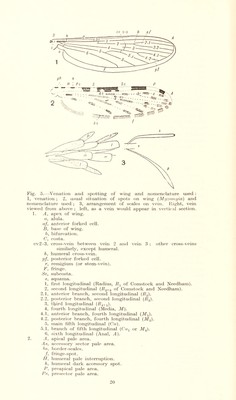
![The pilot axy of flic thorax is shown in I^i”'. 4. The proplcural hairs have already been referred to. Of the other pleural cli;cta\ t lit1 ttpiracular are commonly from 0-5 in number ; the prealar form a conspicuous tuft in some species, but are minute and difficult to make out in others; the filer no pleural are usually divided into two groups, an upper and a lower, and consist of small as well as larger hairs; the upper mesepimeral are usually 15 or more in number and conspicuous. Tin* lower mesepimeral on the epimeral plate separated from the upper group are usually absent, but are present in A. barbirostris and some other species. The postnotal (on the plate behind the anterior pronotal lobes) and the postspiraeular (on the chitinizat ion behind the anterior spiracle) appear to be absent throughout the tribe. These hairs, with 1 Ik* exception of the propleural hairs, do not appear to be of very great systematic importance and, as their exact number appears to vary in the same species, only outstanding characters, if such exist, are usually given in the descriptions. Scab's are not infrequently present on the sternopleuron or mesepimeron, and their presence or absence may help in the differentiation of certain forms. Wing. The nomenclature of parts of the wing and of the venation . . . are shown in Fig. 5. In the descriptions, for brevity the longitudinal veins and their branches are indicated by numbers, e.g. 2, 2.1, 2.2 indicate respectively the stem, the anterior, and tin* posterior branch of the second longitudinal vein.* “ The length of the wing, measured from the origin of the costa to the level of the apex, is ordinarily, in Anophelini, about 21 times the length of the thorax measured from the anterior promontory to the back of the scutellum, but is pro¬ portionately more (up to three times or slightly over) in large¬ winged species such as .4. hj/rcanus. The greatest width, excluding the fringe, is usually slightly over \ the length ; the wing in the male is slightly narrower, about ! the length. The subcosta joins the costa slightly under | the length of the wing from the base (0-62-0-65 of the wing-length). The anterior forked cell in the female usually measures ] or slightly more of the length of the wing . . . The relative lengths of the two forked cells, measured along the posterior branch in each case, is the forked cell index (usually about 1 -5, but reaching 2 in some species where the anterior forked cell is very long). The length of the anterior forked cell in relation to its petiole (from the bifurcation to the cross-vein) is often very variable in the same species, but may be used to give a general indication of the length of the cell. The forked cells are usually slightly shorter in the male. * This nomenclature, which is in common use among workers on the Culicidse, has probably followed that given by Theobald (Vol. I, p. is). Theobald appears to have followed Skns'e (Prnc. Linn. 8ov. X. 8. Wales, III, 1889, p. 1763, pi. 40), his figure being a copy of that given by skuse, who seems to have been the first to adapt to the wing of the mosquito the system of nomenclature in common use among students of the Diptera in the latter half of the nineteenth century. Among students of the Culicidse many of the cell-names and other unnecessary detail have gradually dropped out of use ; all that is now necessary is given in the accompanying figure. Ill](https://iiif.wellcomecollection.org/image/b29809174_0021.jp2/full/800%2C/0/default.jpg)