Miracle or menace? : biotechnology and the third world / by Robert Walgate.
- Walgate, Robert
- Date:
- [1990]
Licence: Attribution-NonCommercial-NoDerivatives 4.0 International (CC BY-NC-ND 4.0)
Credit: Miracle or menace? : biotechnology and the third world / by Robert Walgate. Source: Wellcome Collection.
110/212 page 100
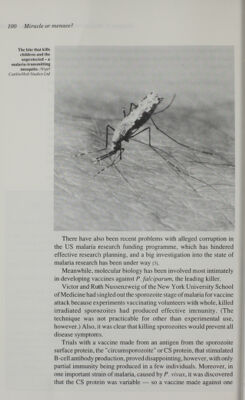
![100 Miracle or menaceì The bite that kills children and the unprotected - a malaria-transmitting mosquito. iNigel Cattlin/Holt Studios Ltd There have also been recent problems with alleged corruption in the US malaria research funding programme, which has hindered effective research planning, and a big investigation into the state of malaria research has been under way [3]. Meanwhile, molecular biology has been involved most intimately in developing vaccines against P. falciparum, the leading killer. Victor and Ruth Nussenzweig of the New York University School of Medicine had singled out the sporozoite stage of malaria for vaccine attack because experiments vaccinating volunteers with whole, killed irradiated sporozoites had produced effective immunity. (The technique was not practicable for other than experimental use, however.) Also, it was clear that killing sporozoites would prevent all disease symptoms. Trials with a vaccine made from an antigen from the sporozoite surface protein, the circumsporozoite or CS protein, that stimulated B-cell antibody production, proved disappointing, however, with only partial immunity being produced in a few individuals. Moreover, in one important strain of malaria, caused by P. vivax, it was discovered that the CS protein was variable — so a vaccine made against one](https://iiif.wellcomecollection.org/image/b18035644_0111.JP2/full/800%2C/0/default.jpg)
 No text description is available for this image
 No text description is available for this image
 No text description is available for this image