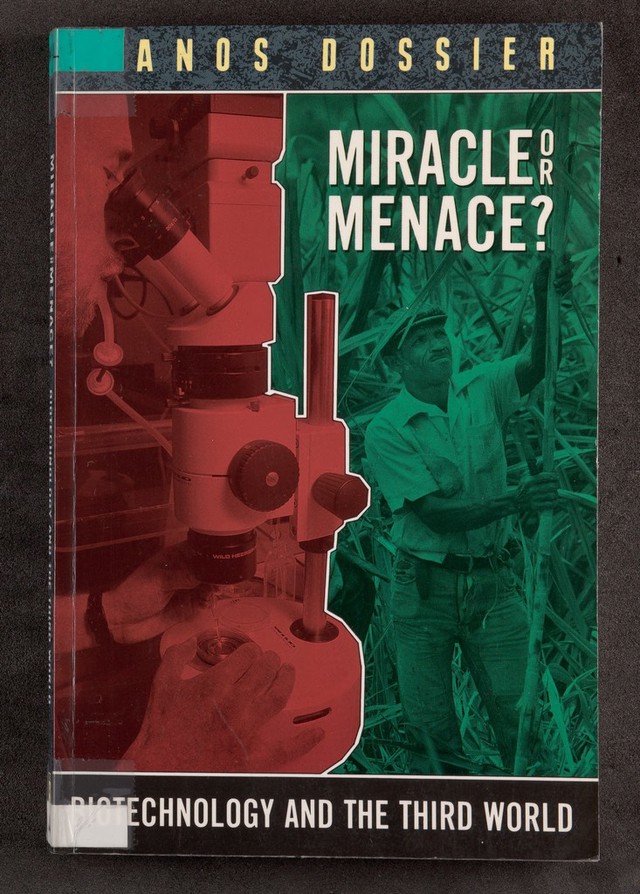
Miracle or menace? : biotechnology and the third world / by Robert Walgate.
- Walgate, Robert
- Date:
- [1990]
Licence: Attribution-NonCommercial-NoDerivatives 4.0 International (CC BY-NC-ND 4.0)
Credit: Miracle or menace? : biotechnology and the third world / by Robert Walgate. Source: Wellcome Collection.
161/212 page 151
![Chapter 10: Private and public biotechnology 151 China but wouldn't hold up in any free market economy. Panos sought, and received, information about the programme from senior sources at Ring Around. But lawyers of the parent, Occidental Petroleum, then wrote to Panos saying that the company did not wish to make any statement. Other sources, however, confirmed that Ring Around Products have continued in their efforts to develop hybrid rice suitable for the US market — and have patented a hybrid rice seed production process. On 16 August 1988, Ring Around took out US Patent Number 4,764,643 for a route to hybrid rice production. A US AID official was concerned that patents on the technology were blocking its future commercial use — because the patent holders had not found the technology profitable or effective in Northern markets. The official told Panos that, if this were true, the company should be encouraged to release its technology into the public domain. The Chinese Government indicated to irate FAO officials in early- 1989 that it hoped to help release the technology. But even if China does have the legal power to do so (having contracted the technology to the companies), some commentators have been sceptical of Chinese intentions. The strategic value of being first in the race to develop and patent commercial rice hybrids is high. And China, they say, has a reputation for being astute about retaining control of germplasm — valuable plants — and has always been reluctant to make them available internationally. Neil Rutger, of the US Department of Agriculture, says: Research scientists have known for 25 years that, if you could develop a high-yielding, disease-resistant hybrid, this would open the way for proprietary control, thus confirming Pioneer Hi-Bred's views expressed earlier in this chapter. Henk Hobbelink, of Seeds Action Network, an international non¬ governmental pressure group, adds: Once hybrids have been developed that are commercially viable in the rice bowls of Asia, the interest of private companies will increase dramatically. Public funding for seed production programmes will be replaced by private capital. With this, the public control of a major food crop would cease. You can look to India to see how fast this occurs, he says. In 1988, India started a new seed policy. Previously all seed production was done publicly. [Now farmers are allowed to import seeds from abroad.] Within a year at least three agro-industrial multinationals — Pepsi Cola, Royal Sluis, Pioneer — have moved in to take up the market. There is no indication that this will in the long run benefit the bulk of Indian farmers. Indeed the lessons of the Green Revolution](https://iiif.wellcomecollection.org/image/b18035644_0162.JP2/full/800%2C/0/default.jpg)