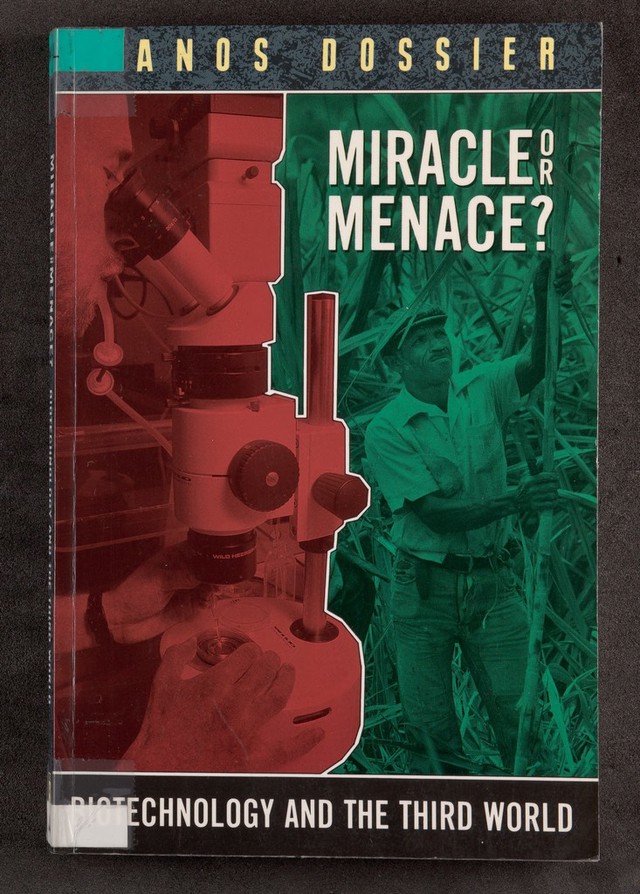
Miracle or menace? : biotechnology and the third world / by Robert Walgate.
- Walgate, Robert
- Date:
- [1990]
Licence: Attribution-NonCommercial-NoDerivatives 4.0 International (CC BY-NC-ND 4.0)
Credit: Miracle or menace? : biotechnology and the third world / by Robert Walgate. Source: Wellcome Collection.
180/212 page 170
![170 Miracle or menace? the movement of plants and animals to prevent the introduction of foreign pests and diseases, or of insects and microbes that may become troublesome if introduced into countries where their natural predators are absent. Proponents of genetic engineering consider that, in most cases, the introduction of one or two genes into a plant, animal or microbe, is unlikely to produce anything as potentially dangerous as some of these previous introductions of alien organisms. But ecologists are more cautious. A committee of the Ecological Society of America, for example, while broadly welcoming the benefits that biotechnology could bring, urges caution in environmental releases, pointing out that, although the capability to produce precise genetic alterations increases confidence that unintended changes in the genome [the total genetic make-up of an organism] have not occurred, precise genetic characterisation does not ensure that all ecologically important aspects of the phenotype [the biological properties of an organism] can be predicted for the environments into which an organism will be introduced [2]. Submitting evidence to the UK Royal Commission on Environmental Pollution, the UK Genetics Forum, a collection of scientists, academics, environmentalists, consumer representatives, and animal welfarists, has recommended that a partial moratorium on the release of genetically engineered organisms to the environment should be instituted. It should run until ecological research has significantly improved our ability to assess the risks involved, and a full public debate has been stimulated. During this period genetically engineered organisms should only be released to the environment in order to further our understanding of their behaviour in natural systems [3]. It is probably true to say that, among scientists at least, the worry is not so much how a particular genetically changed organism has been produced, but what it might do when released. Comments the Ecological Society of America: Genetically engineered organisms should be evaluated and regulated according to their biological properties (phenotypes), rather than according to the genetic techniques used to produce them. There are, however, certain distinctions between old-fashioned gene movements and the products of genetic engineering, which could add to the risks: • The short time-scale on which genes are being moved and introduced will allow little time for testing or ecological adjustment. There are fears that pressure from the increasing number of planned releases, and pressure from industry, will](https://iiif.wellcomecollection.org/image/b18035644_0181.JP2/full/800%2C/0/default.jpg)