Miracle or menace? : biotechnology and the third world / by Robert Walgate.
- Walgate, Robert
- Date:
- [1990]
Licence: Attribution-NonCommercial-NoDerivatives 4.0 International (CC BY-NC-ND 4.0)
Credit: Miracle or menace? : biotechnology and the third world / by Robert Walgate. Source: Wellcome Collection.
39/212 page 29
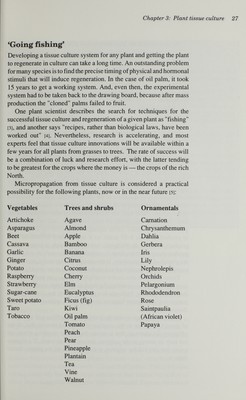
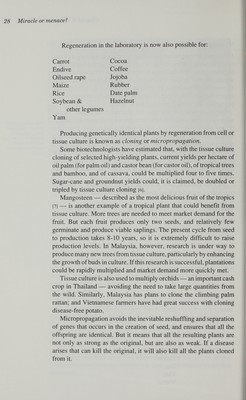
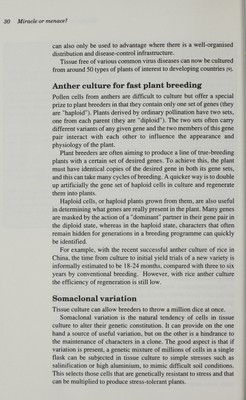
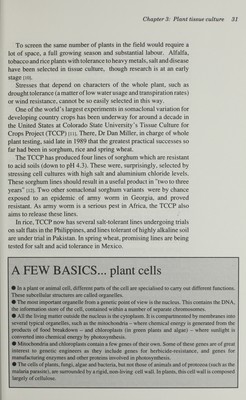
![Chapter 3: Plant tissue culture 29 Vietnam's success with potato In one rural valley near North Vietnam's capital, Hanoi, the tissue culture of virus-free, high-yield potatoes has become a cottage industry, producing millions of plants for the region's farmers more cheaply than imported seed potatos. The Vietnamese used to grow European potatoes. But imports of new seed tubers fell during the last Vietnam war, and existing stock became infected. The government got scientists working on tissue culture and regeneration. The result: a farmer-friendly technology usable in basic conditions, and not even needing electricity. The equipment is sterihsed in home-made autoclaves (high-pressure steamers) made from old US gas cylinders perched on wood fires, and the plantlets are rooted in small banana-leaf pots. Women, children and grandparents soon became cloning experts. Using a growth medium made from fertiliser solidified with gelatin, each family was able to produce up to 150,000 plants per year. Production in the valley reached 3 million plants at one stage. John Dodds, of the ]Intemational Centre for Potato Research (CIP) in Lima, Peru, visited the project, and was impressed. But he found that the tissue culture material was not completely disease-free and the varieties being cloned were not well-adapted to the locality. So CIP sent in 10 varieties, some with disease resistance, for small-scale trials. The most appropriate were quickly adopted. In the developing world, potatoes are only the 11 th crop in food terms, but in money terms they are already the fourth largest crop after rice, wheat and maize, says Dodds. The potato produces more calories per hectare per year in the form of food than any other crop; and for rural people it is becoming an income-boosting crop, based on the growing urban fast food market. Production has tripled since the 1950s. Disease-free stock Many plant diseases and pests are virtually impossible to get rid of once infection has occurred, with the disease being carried through seeds, cuttings or offsets into the next generation of plants as well. One answer is to replant with disease-free, clean stock, obtained through tissue culture. Meristems, used as the source tissue in the tissue culture of dicots, are the only parts of the plant that remain free of virus, bacteria or fungi when the rest of the plant is diseased, so meristem culture is generally clean [8]. In this way, disease-free plant material can also be produced in large amounts. Given regeneration, this allows the multiplication of disease-free plants, and the movement of plant breeding material about the world without fear of introducing disease. In tropical conditions, problems can arise in maintaining disease-free stocks of tissue or plants. In some cases, virus-free clones have become even more severely affected than before. This is because certain relatively harmless virus infections that inhibit the action of other, more dangerous ones, have been eliminated. Disease-free stock](https://iiif.wellcomecollection.org/image/b18035644_0040.JP2/full/800%2C/0/default.jpg)


 No text description is available for this image
 No text description is available for this image
 No text description is available for this image