Miracle or menace? : biotechnology and the third world / by Robert Walgate.
- Walgate, Robert
- Date:
- [1990]
Licence: Attribution-NonCommercial-NoDerivatives 4.0 International (CC BY-NC-ND 4.0)
Credit: Miracle or menace? : biotechnology and the third world / by Robert Walgate. Source: Wellcome Collection.
87/212 page 77
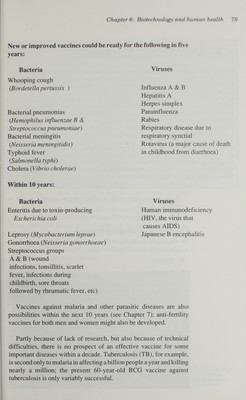
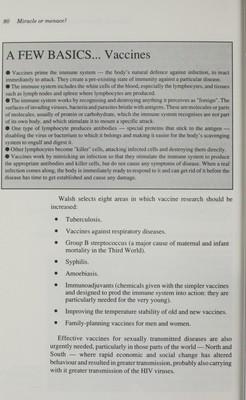
![Chapter 6: Biotechnology and human health NEW MEDICAL BIOTECHNOLOGY Biotechnology offers no immediate cure-all for diseases that have complex economic, environmental and social causes, as well as medical ones. But it does hold some promise. Three key technologies need to be researched, developed and applied in developing country conditions: new and improved vaccines; diagnostic kits; and new drugs. Vaccine research: the goals Vaccines are the most important health measure, says Walsh, because they are trebly effective — against sickness, death and transmission. Drugs and diagnostic tools have a slightly lower priority as they usually only come into play once a patient is ill. Then come environmental health and improved nutrition through crop improvement. Vaccines also have another spin-off — they can be a stimulus to the health system. Speaking of the campaign begun in 1988 to eradicate polio, Ciro de Quadros, Latin American regional director of the Pan American Health Organization (РАНО), told Panos: Polio is a vehicle. It will help us deliver a whole health structure. De Quadros' experience is that programmes like WHO's Extended Programme of Immunisation, which has delivered six cheap existing vaccines to half the world's children, can, if properly managed, raise the competence, standing, and morale of local health personnel, and of the whole health service. Carlos Castillho, representative of the United Nations Children's Fund (UNICEF) in Haiti, felt the same about the first successful vaccination days in Haiti in 1988. Haiti had the lowest level of child immunisation in the Americas. It was very sad, he said. But the vaccination days had been a tremendous victory — a miracle. However, such successes need excellent organisation which is sensitive to local need, and designed to leave not just vaccines behind, but also organisational structures and new social and political attitudes and demands. Any new vaccine must be deliverable through the primary health¬ care system, right through to distant villages still not served by roads, water or electricity. An ideal new vaccine for a developing country should be [4]: • Stable at tropical temperatures for long periods (several existing ones, such as polio and measles, are not ). • Easy to administer through a cheap, disposable device not requiring sterilisation.](https://iiif.wellcomecollection.org/image/b18035644_0088.JP2/full/800%2C/0/default.jpg)
 No text description is available for this image
 No text description is available for this image
 No text description is available for this image