The social insects : their origin and evolution / by William Morton Wheeler.
- Wheeler, William Morton, 1865-1937. Sociétés d'insectes. English
- Date:
- 1928
Licence: In copyright
Credit: The social insects : their origin and evolution / by William Morton Wheeler. Source: Wellcome Collection.
153/470 (page 113)
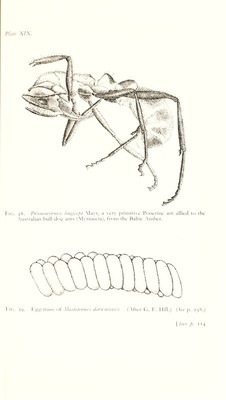
![It is interesting to note that this ver\' family Tiphiidæ has affinities in structures and habits with the Bethylidæ, considered in a former lecture. Probably all three convergent groups, the Bethjdidae, Tiphiidæ and Formi- cidæ, had a common origin among extinct forms, which may be conceived to have resembled the existing Bethylids in habits. They probably hunted insect prey, paralysed and carried it into their burrows and laid their eggs on it, the mother insect remaining with her young till they had matured. From such a sub¬ social stage we might pass rather easily to the social stage now existing among all ants by assuming that the emerging daughters became attached to their mother and brought their prey into the maternal burrow. Eventually a physiological division of labour gradually developed among the associated individuals through the colon5'-founding female learning to feed her first brood with her saliva or eggs instead of with prey while her daughters became sterile nurses of her subsequent broods. We may assume also that these ancient Bethyloid or Tiphioid ant-ancestors had both winged and wingless females like Scleroderma (see p. 62). This assumption would furnish the necessary starting point for the three forms of females, fertile and winged, fertile and apterous, and sterile and apterous (workers) which we find among existing ants and thus avoid Emery’s inherentl}^ improbable derivation of alate from apterous females through inheritance of wings from the males. The present aptery of the females of Mutillidæ, Thynnidæ, etc., might also be traced to the female dimorphism of remote Betliyloid ancestors, but we should have to assume that in them no advance occurred in behaviour pattern even to a sub-social stage like that of Sclero¬ derma. Perhaps the only result of this discussion, which, I fear, has been pushed to the jioint of ennui, is that the Formicidæ bear much the same phylogenetic relations to the lowermost families of Aculeata, and es])ecially to the Tiphiidæ and Bethylida', that the social Vespids bear to the Eumeninæ and the bees to the family Sj)hecidæ.](https://iiif.wellcomecollection.org/image/b29809198_0153.jp2/full/800%2C/0/default.jpg)