The social insects : their origin and evolution / by William Morton Wheeler.
- Wheeler, William Morton, 1865-1937. Sociétés d'insectes. English
- Date:
- 1928
Licence: In copyright
Credit: The social insects : their origin and evolution / by William Morton Wheeler. Source: Wellcome Collection.
167/470 (page 125)
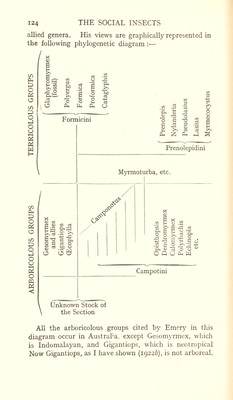
![In Briti?h Guiana I found it nesting in old logs on the ground and Dr. W. ]\I. Mann informs me that he has taken it under stones in Bolivia. Gesomyrmex, too, is probably terriadous. The types of G. howardi were sent to me mingled with a lot of well-known soil-inhabiting ants. According to m}^ observations at least some of the species of Opisthopsis and Calomyrmex nest in the earth. Of the various subgenera of Polyrhachis all the Australian species of Campomyrma, Hagiomyrma and Chariomyrma are terricolous and moreov^er, like Calomyrmex, distinctly xerophilous. In Africa certain members of the sub¬ genus Myrma are terricolous and the same is probably true of some of its East Indian species. Nothing is knowm of the habits of Echinopla, but it is probably arboricolous. This genus, Œcophylla, Dendromyrmex, and some subgenera of Camponotus and Polyrhachis therefore alone belong wholly below the dotted line in Emery’s diagram. And wEen we confine our attention to Camponotus w^e find that the terricolous subgenera, Tanæmyrmex (=]\Iyrmoturba), Dinomyrmex, Myrmoser- icus, etc., are obviously much more primitive than the sub-genera Myrmorhachis, Colobopsis and its allies, etc., which have the head and mandibles of the queen and soldier more or less specialized for living in wood. Here again it wall be noticed that Tanæmyrmex, wdiich embraces a considerable number of species, sub¬ species, and varieties, is highly xerophilous, since most of its forms are confined to somewhat arid or desert regions. In North America Tanæmyrmex occurs only in the drier portions of the South-Western and Western States. The evolution of the Eucamponotini, therefore, in my opinion, has been just the reverse of the one outlined by Emery. I regard as equally fallacious his contention that the ancestral ants which gave rise to Œcophylla, Camponotus and Polyrhachis had the habit of employing their larvæ to spin leaves and detritus together in making the nest. This habit, now so wæll- known in Œcophylla, occurs only in two among several hundred Neotropical species of Camponotus and in](https://iiif.wellcomecollection.org/image/b29809198_0167.jp2/full/800%2C/0/default.jpg)