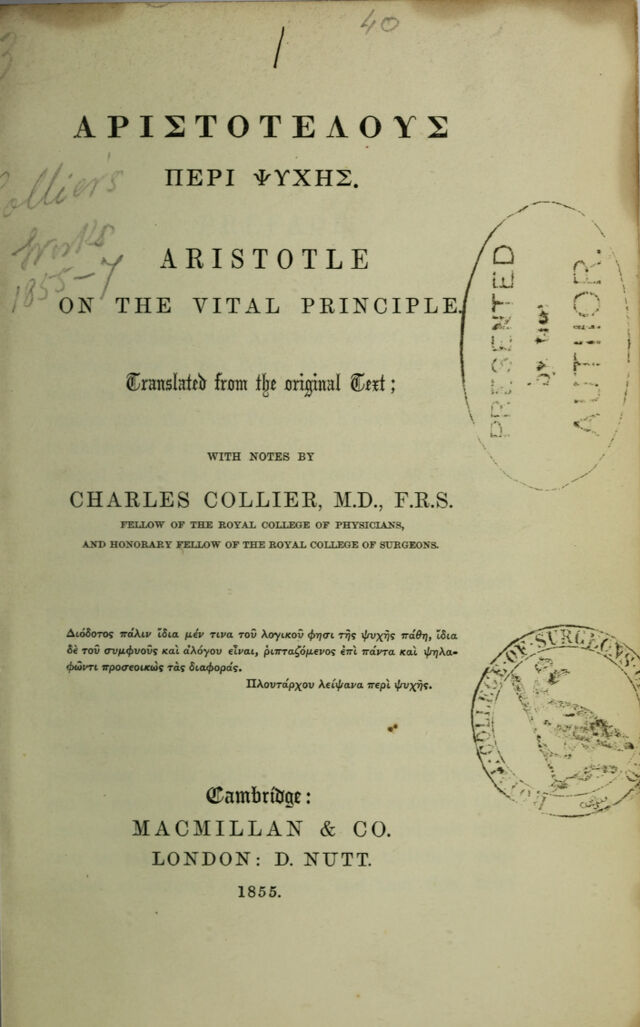
Aristotelous peri psyches = Aristotle on the vital principle / translated from the original text, with notes by Charles Collier.
- Aristotle, 384 B.C.-322 B.C.
- Date:
- 1855
Licence: Public Domain Mark
Credit: Aristotelous peri psyches = Aristotle on the vital principle / translated from the original text, with notes by Charles Collier. Source: Wellcome Collection.
Provider: This material has been provided by The Royal College of Surgeons of England. The original may be consulted at The Royal College of Surgeons of England.
331/332 page 325
![all sensual impressions to the one impression by contact, J and this generalisation is supported by some modern writers and regarded as the theory of Sensation. “ There1 may, however, be many other impressions derived from outward bodies, for which the sensitive nerves of the lower animals are adapted, besides those which affect us, and we cannot always be certain of the identity of the feelings communicated to them by organs which appear analogous to our own.” Note 3, p. 193. On which account, other sentient, &c.] This is consonant with the opinion that the Touch is the only sense necessary to animal existence; although the organs of relation are required for the higher forms of being. Thus, impressions in excess upon those organs, whether by colour, sound, or odour, may injure or pervert the senses, but cannot further affect the individual; while tangible impressions, hot, cold, or hard, can together with the sense destroy the animal. Note 4, p. 193. Animals, in fact, possess...the other senses, <fcc.] This is referrible, of course, only to the higher orders of animals, as they alone require such organs for the exercise of their faculties, and the enjoy- ment of their existence. The Tongue is here introduced, whether by inadvertence or in submission to common opinion, as if it were a sense, or the sole organ for speech; and yet, as the chief of the organs for taste](https://iiif.wellcomecollection.org/image/b22308477_0335.jp2/full/800%2C/0/default.jpg)


 No text description is available for this image
 No text description is available for this image
 No text description is available for this image