Volume 1
The science and art of surgery : a treatise on surgical injuries, diseases, and operations / by John Eric Erichsen.
- Date:
- 1895
Licence: Public Domain Mark
Credit: The science and art of surgery : a treatise on surgical injuries, diseases, and operations / by John Eric Erichsen. Source: Wellcome Collection.
Provider: This material has been provided by the Royal College of Physicians of Edinburgh. The original may be consulted at the Royal College of Physicians of Edinburgh.
119/1272 (page 87)
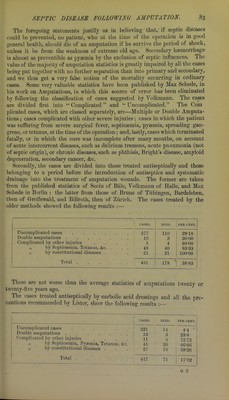
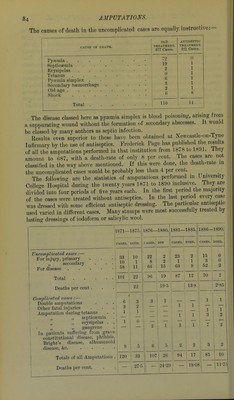
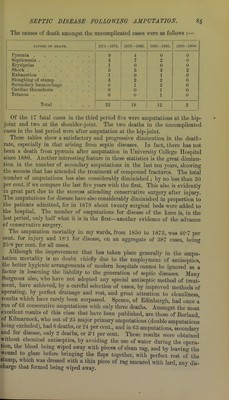
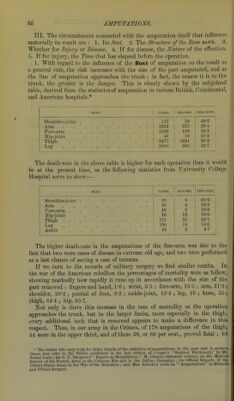
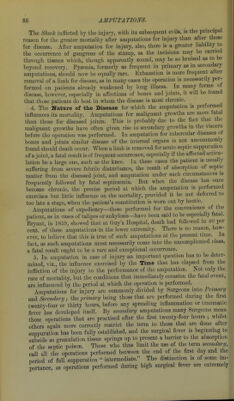
![were in the middle third, and of these 41, or GO per cent., died ; whilst in the lower third the mortality out of 66 cases was 87, or 56 per cent. The size of the part removed and its proximity to the trunk have also con- siderable influence on the canse of death. Thus after the smaller amputations death occurs only in unhealthy states of the constitution, or from the occur- rence of erysipelas, or of some other infective process originating in the wound. In the larger amputations in addition to these causes of death, shock is fre- quently fatal, often aggravated by loss of blood before or during the operation. The larger the vessels divided the more likely is secondary haemorrhage to occur. 2. The Part of the Bone that is sawn through may influence the result. WhencA'er the medullary canal is opened, if the patient be exposed to bad hygienic surroundings, and putrefaction of the discharges be not prevented, there is danger of septic suppuration taking place in the medulla, a condition very frequently followed by pytemia. Amputations through the cancellous ends of long bones are comparatively free from this danger, and consequently show a lower mortality. Tu disarticulations this complication can hardly occur. 3. The mortality resulting from amputations is influenced to a great extent by the Cause for which the operation is performed, being far greater in corre- sponding parts after injury than after disease. The fore-arm and ankle, how- ever, seem to be exceptions to this rule, for the reason that amputations in these regions cause little shock, and the vessels divided are small, and secondary htemorrhage is rare. Thus two important causes of death are eliminated, and a healthy patient usually recovers. When the amputation is performed for disease, however, it is most commonly in cases of tuberculous caries, m which, owing to the general condition, other means have failed to cure. The following table gives the result of numerous cases in civil practice, collected from various sources. (See note, p. 86.) SEAT. Injury. Disease. CASES. DEATHS. PER CENT. CASES. DEATH.S. PER CENT. Thigh !)f;4 576 59-7 1465 477 32-5 Leg . . . . 771 356 46-1 1281 301 23-5 Arm .... 514 180 344 250 65 26-0 Fore-arm . . . • :5()0 38 10-5 151 23 15-9 The following statistics from University College Hospital, being of more recent date, show somewhat better results :— SEAT. Jiijury. 1 Disease. CASES. DEATHS. PER CENT. 1 CASES. DEATHS. PER CENT. Hip .... Thigh .... Leg .... Ankle . . . , Shoulder . Arm . . . . Fore-arm . 2 31 44 6 6 20 • 24 1 12 9 0 3 1 4 50-0 3S-7 24-5 0 50-0 5-0 ] 3-3 1 14 120 56 36 1 13 ' 10 25 11 23 5 2 I 4 78-4 19-1 8-9 5-5 23-0 30-0 IGO](https://iiif.wellcomecollection.org/image/b2197407x_0001_0119.jp2/full/800%2C/0/default.jpg)