Volume 1
The science and art of surgery : a treatise on surgical injuries, diseases, and operations / by John Eric Erichsen.
- Date:
- 1895
Licence: Public Domain Mark
Credit: The science and art of surgery : a treatise on surgical injuries, diseases, and operations / by John Eric Erichsen. Source: Wellcome Collection.
Provider: This material has been provided by the Royal College of Physicians of Edinburgh. The original may be consulted at the Royal College of Physicians of Edinburgh.
145/1272 (page 113)
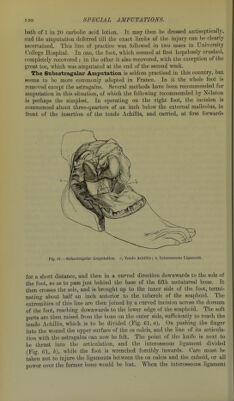
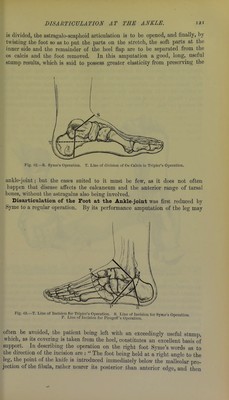
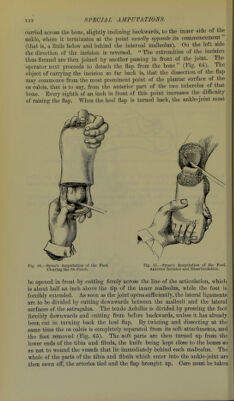
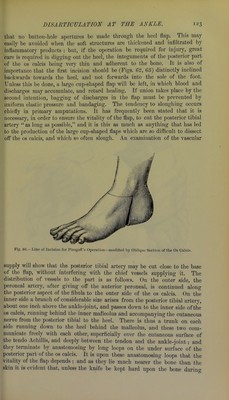
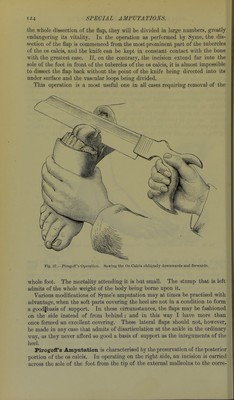
![knife has reached the middle of the proximal phalanx, and should pass, on the inner side, over the line of the articulation between the two phalanges. This amount of covering will not be found more than sufficient. In operations for injury it is not always possible to save so much, but all should be preserved that can be. Anatomical Guides in the Foot.—In operating on the foot beyond the removal of separate toes, certain anatomical guiding points must be kept in mind some of which are usually perceptible even in cases of disease. Oppo- site the ankle-joint are the two malleoli. The tips of these, it must be remembered, are not opposite each other, the external being lower down and posterior, so that when, in Syme's operation, or in Pirogoff's, the direc- tion is given to cut from the tip of the outer malleolus to the corresponding Fig. o3.--Iiicision and Position of Joint in Amputation of a Toe. point on the other side, it means to a point a little behind and below the inner malleolus. The next point of importance on the inner side is the tubercle of the scaphoid, which forms a rounded prominence about half an inch in width Its posterior border corresponds to the articulation between the scaphoid and the head of the astragalus and its anterior to that between the sca]ilioid and the internal cuneiform. The internal cuneiform is about one inch in length so that at that distance from the anterior edge of the tubercle of the scaphoid will be found the articulation between the cuneiform and the metatarsal bone of the great toe, immediately in front of which is the well marked tubercle at the base of that bone. On the outer side, below and a little in front of the external malleolus, is the outer tubercle of the os calcis, which is often but indistinctly felt. About the middle of the foot the tubercle at the base of the fifth metatarsal bone forms a very marked prominence. Midway between the base of the fifth metatarsal bone and the tip of the external malleolus is the articulation between the cuboid and the os calcis; and this point is exactly opposite the tubercle of the scaphoid on the inner side. VOL. I. I](https://iiif.wellcomecollection.org/image/b2197407x_0001_0145.jp2/full/800%2C/0/default.jpg)