The London years of Benjamin Waterhouse / [Josiah Charles Trent].
- Josiah Charles Trent
- Date:
- [1946]
Licence: In copyright
Credit: The London years of Benjamin Waterhouse / [Josiah Charles Trent]. Source: Wellcome Collection.
16/24 page 34
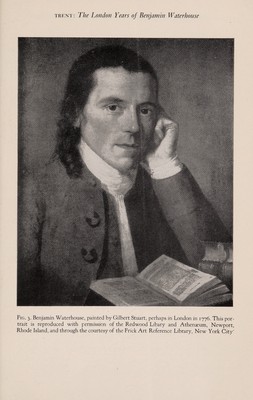
![We found nothing equal to the collection at the Queen’s Palace or Buckingham House. We made it a point also to walk, together through all the narrow lanes of London, and having a pocket map, we marked such streets and lanes as we passed through with a red lead pencil, and our map was full two thirds streaked over with red when we received some solemn cautions and advice to desist from our too curious rambles. We were told by some who knew better than we did, that we run a risk of bodily injury, or the loss of our hats and watches, if not our lives, when we gave up the project. We had, however, pursued it once a week for more than two years, and never experienced other than verbal abuse, chiefly from women, and saw a great deal of that dirty, monstrous, overgrown city, containing to ap¬ pearance, no other people than the natives of Britain and Ireland, and a few Jews, not laughing and humming a song like the populace of Paris, but, wearing a stern, anxious, discontented phiz. (I, 173) The two enjoyed numerous conversations — on anatomy and botany, no doubt, as well as music and painting, for Waterhouse testifies to the tact with which Stuart adapted his talk to the company in which he found himself. They had painting sessions, Waterhouse serving as model: the Stuart portrait of Waterhouse, now in the Redwood Library at Newport (see Fig. 3), is perhaps one of the results of these sittings; Waterhouse’s description of another is sufficiently delightful to make us sincerely regret its loss: \ I once prevailed on [Stuart] to try his pencil on a canvass of a three-quarter size, representing me with both hands clasping my right knee, thrown over my left one, and looking steadfastly on a human skull placed on a polished mahogany table, (h i74) In 1778, shortly before Waterhouse’s departure for Leyden, Stuart painted a self-portrait, which he gave to his friend; it was hanging in Waterhouse’s Cambridge home when Stuart visited him there in 1805, and the artist was gratified to find his early work so creditable. A loyal American living in England while his country was rebelling against British dominion, Waterhouse had occasion for much anxiety: “Medicine and Politics were mixed together in a young, ardent, and anxious brain, far distant from his suffering country!”29 In his patron’s home, he was sure of sympathy in his concern about American affairs. Fothergill and many of his associates, though loyal Englishmen, saw the justice of the American cause. Only a month before Waterhouse reached London, Fothergill was collaborating with Benjamin Franklin and David Barclay in an effort to avert hostilities. In his patron’s home, also, Water- house was in the way of receiving early information on each new develop- *' Essay on Junius, p. viii.](https://iiif.wellcomecollection.org/image/b30632249_0016.jp2/full/800%2C/0/default.jpg)
 No text description is available for this image
 No text description is available for this image
 No text description is available for this image