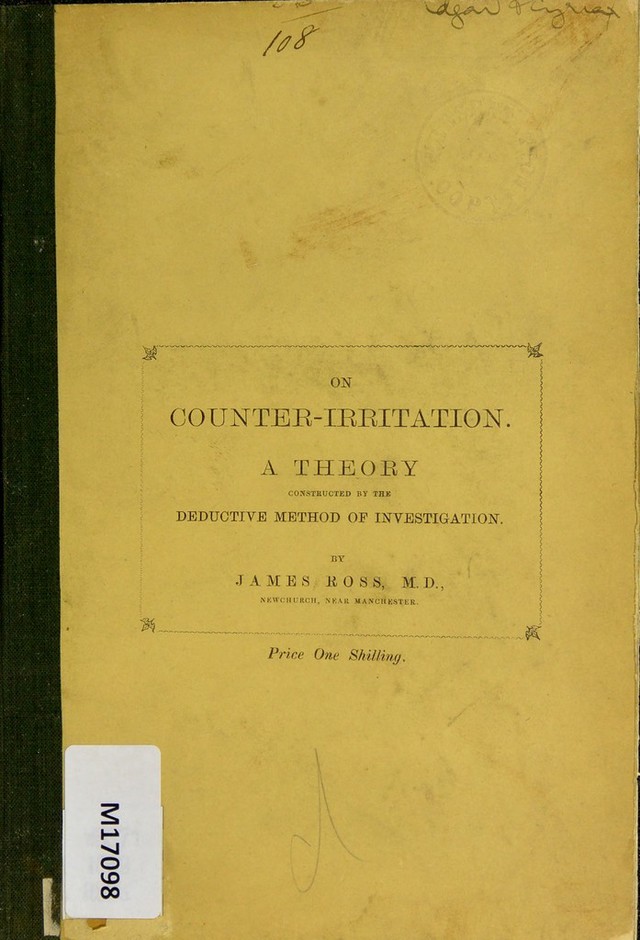
On counter-irritation : a theory constructed by the deductive method of investigation / by James Ross.
- James Ross
- Date:
- 1869
Licence: Public Domain Mark
Credit: On counter-irritation : a theory constructed by the deductive method of investigation / by James Ross. Source: Wellcome Collection.
38/48 page 36
![elements of which living tissues are composed should soon be propagated to the surrounding molecules^ nor will it ])c difficult to conceive that this motion should make its way from one structure to another in contact with it. It is also a well ascertained fact that a very extensive series of changes may be set in motion within the body by a cause which would be regarded as inappreciable if measured by any known standard of comparison except the effects which it produces on the living body. Inoculation with a small quantity of the secretion of smallpox maybe cited as an example. These considerations^ therefore^ may assist the mind in forming the conception that irritation of the surface of the body mav spread directly through the tissues^ and to such an extent as to produce an action upon the internal organs. But even after it is conceded that irritation of the surface of the body spreads inwards to such an extent as to affect the internal organs in some degree, another difficulty remains to be solved. It might be urged that the intensity of this irrita- tion is not so great as to account for the action of counter- irritation upon the morbid structures in its vicinity. When the surface of a healthy body is irritated there are no appa- rent signs by which it can be recognised that the irritation has extended beyond the immediate neighbourhood to which the irritant has been applied, and even when the irritation has been long continued the only appreciable signs of the extension of the irritation to the surrounding textures are such as are afforded by the over-growth of the hair. The effect, therefore, which irritation produces upon the sur- rounding healthy textures being so small, it may be argued that the force which causes this effect must be so feeble as not to account for the almost immediate and even marked effects counter-irritation produces upon morbid structures. This constitutes a real difficulty, but it is one which is not peculiar to this theory, but will arise whatever theory of the action of counter-irritation may be advanced. At the same time, if a solution of this difficulty can be obtained it will be an additional argument in favour of the theory under con- sideration. In the first place, it may be remarked that the force derived from the counter-irritation is not the sole cause of the effects produced upon the surrounding textures, whether these textures are in a healthy or in a morbid condition. The force derived from the counter-irritation merely acts along with a force or forces alreading existing in the part. It is not the sole cause of the effects; it is, as Sir W.](https://iiif.wellcomecollection.org/image/b20412861_0038.jp2/full/800%2C/0/default.jpg)