Spectrum analysis in its application to terrestrial substances, and the physical constitution of the heavenly bodies / familiarly explained by H. Schellen ; translated from the second enlarged and revised German edition by Jane and Caroline Lassell ; edited with notes by William Huggins ; with numerous woodcuts and coloured plates, and Ångström's and Kirchhoff's maps.
- Heinrich Schellen
- Date:
- 1872
Licence: Public Domain Mark
Credit: Spectrum analysis in its application to terrestrial substances, and the physical constitution of the heavenly bodies / familiarly explained by H. Schellen ; translated from the second enlarged and revised German edition by Jane and Caroline Lassell ; edited with notes by William Huggins ; with numerous woodcuts and coloured plates, and Ångström's and Kirchhoff's maps. Source: Wellcome Collection.
53/748 (page 23)
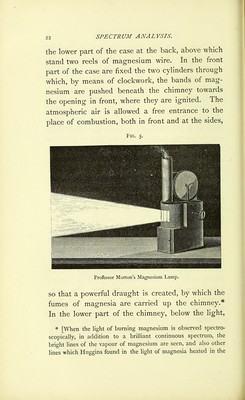
![work eccentric cutters, by which the ashes formed by the combustion are removed from time to time. Above the chimney is placed a bent tin tube of from three to six feet in height, over which is fastened a bag of gauze or muslin, which, without presenting any perceptible hindrance to the current of air, prevents the magnesia dust from escaping. By this contrivance the light is preserved from the prejudicial influence of the vapours; it exceeds in brilliancy that of the lamp described above, and burns with steadiness and regularity. We have dwelt the longer on this light since magnesium plays so important a part in spectrum analysis; but the heat which its combustion gene- rates cannot be used for volatilizing other substances and rendering them luminous, as its brilliancy is so great as to completely overpower their light. Under these circumstances we must seek for a flame which, with the least possible luminosity, shall yet evolve sufficient heat to fuse most metals ; such a flame chemistry furnishes us in the oxyhydrogen blow- pipe. 5. The Oxyhydrogen Flame. In the Bunsen burner the combustion of coal gas ensues slowly and incompletely: slowly, because the oxyhydrogen flame, and which appear to belong to volatilized mag- nesia. The light of magnesium burning in air seems to have a threefold source, luminous vapour of magnesium, luminous vapour of magnesia, but chiefly incandescent solid magnesia from the combination of the metal with the oxygen of the air.]](https://iiif.wellcomecollection.org/image/b28057892_0053.jp2/full/800%2C/0/default.jpg)