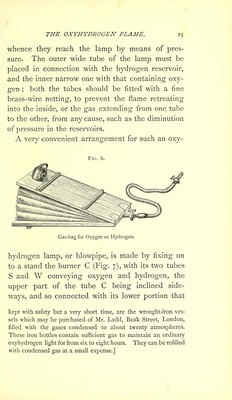
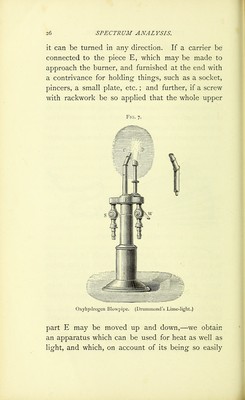
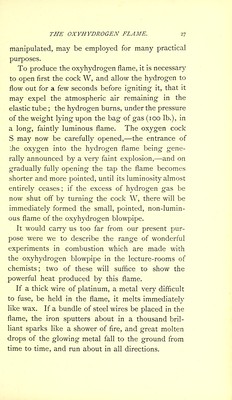
Spectrum analysis in its application to terrestrial substances, and the physical constitution of the heavenly bodies / familiarly explained by H. Schellen ; translated from the second enlarged and revised German edition by Jane and Caroline Lassell ; edited with notes by William Huggins ; with numerous woodcuts and coloured plates, and Ångström's and Kirchhoff's maps.
- Heinrich Schellen
- Date:
- 1872
Licence: Public Domain Mark
Credit: Spectrum analysis in its application to terrestrial substances, and the physical constitution of the heavenly bodies / familiarly explained by H. Schellen ; translated from the second enlarged and revised German edition by Jane and Caroline Lassell ; edited with notes by William Huggins ; with numerous woodcuts and coloured plates, and Ångström's and Kirchhoff's maps. Source: Wellcome Collection.
60/748 (page 30)
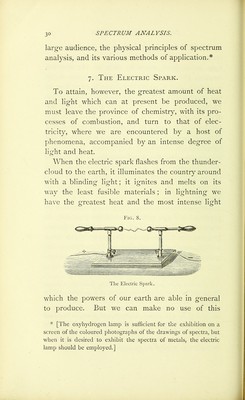
![3° large audience, the physical principles of spectrum analysis, and its various methods of application.* 7. The Electric Spark. To attain, however, the greatest amount of heat and light which can at present be produced, we must leave the province of chemistry, with its pro- cesses of combustion, and turn to that of elec- tricity, where we are encountered by a host of phenomena, accompanied by an intense degree of light and heat. When the electric spark flashes from the thunder- cloud to the earth, it illuminates the country around with a blinding light; it ignites and melts on its way the least fusible materials ; in lightning we have the greatest heat and the most intense light Fig. 8. The Electric Spark. which the powers of our earth are able in general to produce. But we can make no use of this * [The oxyhydrogen lamp is sufficient for the exhibition on a screen of the coloured photographs of the drawings of spectra, but when it is desired to exhibit the spectra of metals, the electric lamp should be employed.]](https://iiif.wellcomecollection.org/image/b28057892_0060.jp2/full/800%2C/0/default.jpg)