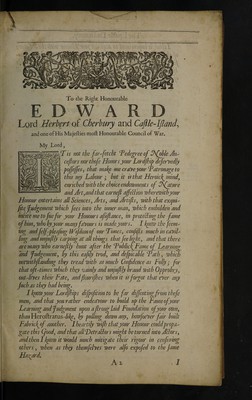
The works of Ambrose Parey, chyrurgeon to Henry II. Francis II. Charles IX. and Henry III. Kings of France. : Wherein are contained an introduction to chirurgery in general : a discourse of animals, and of the excellency of man. The anatomy of man's body. A treatise of praeternatural tumors ... Illustrated with variety of figures, and the cuts of the most useful instruments in chirurgery. Recommended by the University of Paris to all students in physick and chirurgery, particularly such as practised in camps and the sea.
- Ambroise Paré
- Date:
- M DC XCI. [1691]
Licence: Public Domain Mark
Credit: The works of Ambrose Parey, chyrurgeon to Henry II. Francis II. Charles IX. and Henry III. Kings of France. : Wherein are contained an introduction to chirurgery in general : a discourse of animals, and of the excellency of man. The anatomy of man's body. A treatise of praeternatural tumors ... Illustrated with variety of figures, and the cuts of the most useful instruments in chirurgery. Recommended by the University of Paris to all students in physick and chirurgery, particularly such as practised in camps and the sea. Source: Wellcome Collection.
16/816
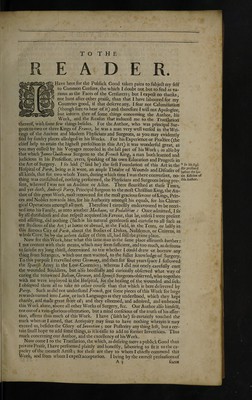
![Vid. l.^, Gslt 1.6, fomeof this Proteffion, chiefly and almoft wholly perfuaded and incited to take this pains, who knowing the difability of underftandmg this Author in Latin or French, in many of the weaker Members of the large Body of their Profeffion, di- fperfed over this Kingdom, and the reft of his Majefties Dominions whofe good and increafe in knowledge may be wifhed, thatfo they m^- be the better enabled to do good to fuch as (hall implore their aid in their Profeflion. There are fome I know will blame me for Engliftiing this Work, as l^mg open theMvfteries of a worthy Art to the unworthy view of the Vulgar. To luch I could anfwer as d^xAxo Alexander : but for the prefent I will g>ve them 4 thefe reafons which I think may fatisfie any but the purpofely malicious. The firft- is drawn from the ™i-d«r/of the thing, as intended for thofe that want fuch Guides to direa them in their Art; for it is commonly granted, that Bonnm quo commumur eo mlitfs. Secondly, it hath been thecuftom of moft Writers in all Ages and Coun¬ tries thus to do: Hippocrates, Galen, and the other Greeks, writ in their Mother Tongue the Myfterics of their Art. Thus did Celfas, Serenus, and others in Lattn : Mefue, Avicen, Serapio, and others, in Arabick.: as alfo, to go no farther, our Author writ this Work in his Native jFre»cA, and learned men have done the like in this, and another Arts. And it is a great hinderance to us in thefe days, that we muft be forced to learn to underftand two or three Tongues before we ^n learn any Science whereas the Ancients learned and taught theirs in their Mother Tongue : fo that they fpent a great deal lefs time about Words, and more upon the Study of, that Art or Science they intended to learn and follow. Thirdly, I muft tell you, that Ex Uhris nemo evafit Artifex, No man becomes a VVorkmanby Books; fo that unlefs they have had fome inlight in the Art, and be in fome fort ai^uainted both with the terms of Art, as.alfo with the knowledge and ufe of the Inftruments thereto belonging, if by reading this, or any other Book of the like nature, they become SurgeSns, I muft needs liken them Galen doth another fort of men*) to Pilots by Book onely; to whole care, I think none of us would commit his fafety at Sea 5 nor any any if wife, will commit themfelves to thefe at Land or Sea either, unlefs wholly deftitute of other. _ . ^ 'fu r- The other things whereof I muft give you notice, are thefe. The Figures la the Anatomy are not the fame ufed by my Author Cwhofe were according to thofe oiVefalim) but according to thofe of Banhine, which were ufed in the Work of T)i.Crook-, and thefe indeed are the better and more compleat. Alfo pag.^19. I thought it better to give the true Figure of the Helmet flowered Aconite, mentioned out of Pliny, than to referve the feigned Pifture of Matthiolms which in our Au¬ thor was increafed with the fbrther fiaion of a Helmet. I have in fome few places in the Margent, which you fliall find marked with a Star, put ftiort annWations, tor the better illuftration of that which is obfenre, &c. I hare alfo in the Text to the fame purpofe, here and there put two or three words, contained in thefe limit [ ] which I find here and there turned into a plain Parenthefis, efpccially toward the latter end of the Book; but the matter is not great. Further I muft acquaint you that the Apology and Voyages, being the laft part of this Work, and not in the Latin but French Editions, were tranflated into Englifliout of French by George Baker a Surgeon of this City, fince that titne, as I hear, dead beyond the Seas. This is all. Courteous Reader, that I have thought neceflary to acquaint thee withal concerning this, which I would defirc thee to take with the lame mind that itis prefented to thee, by him thatwifticth thee all happinels. T^homas fohnfon. THE](https://iiif.wellcomecollection.org/image/b30342843_0016.jp2/full/800%2C/0/default.jpg)