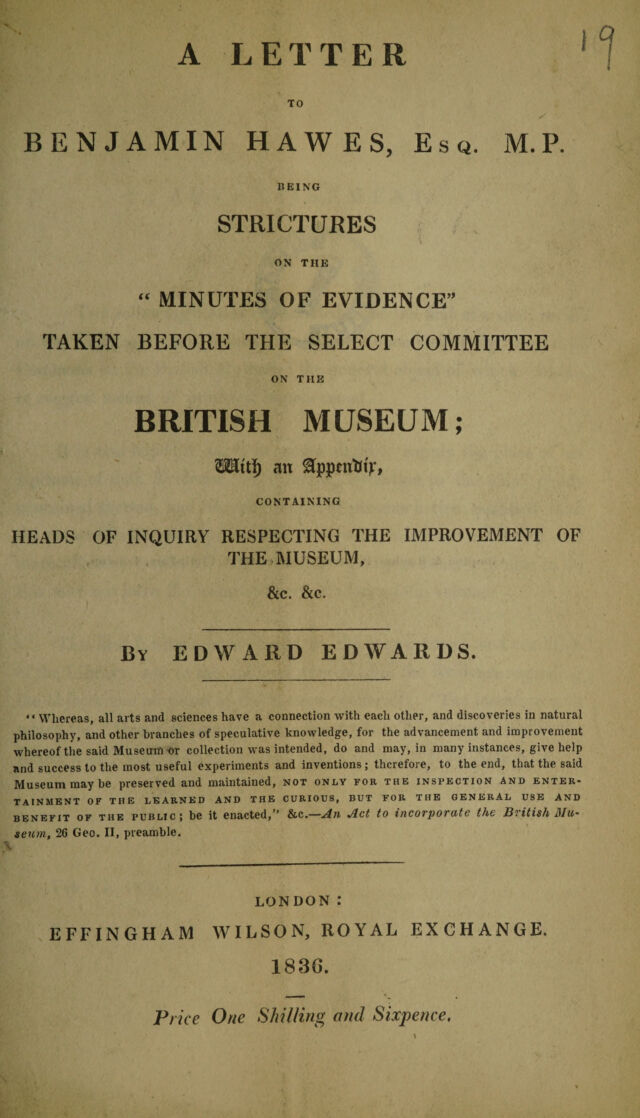
A letter to Benjamin Hawes, Esq., M.P., being strictures on the minutes of evidence taken before the Select Committee on the British Museum; with an appendix, containing heads of inquiry respecting the improvement of the Museum / [Edward Edwards].
- Edward Edwards
- Date:
- 1836
Licence: Public Domain Mark
Credit: A letter to Benjamin Hawes, Esq., M.P., being strictures on the minutes of evidence taken before the Select Committee on the British Museum; with an appendix, containing heads of inquiry respecting the improvement of the Museum / [Edward Edwards]. Source: Wellcome Collection.
16/60 page 16
![Again I ask, where is Mr. Forshall’s authority for stating that the Library of the British Museum was not intended to be a library of education ? After an allusion to the late Mr. Roscoe, of Liverpool, as “ a gentleman known to have been engaged in business, yet to have un¬ dertaken and completed various important literary works,”[1290] and an admission that he would “ undoubtedly have found many more opportunities to have consulted it, if the library had been open to him during those hours when he was not necessarily engaged in business,” [1291]—the examination proceeds : [1292 ]—Do you not think there are many such persons, lawyers for instance, in London ?—1 think there may be many who desire, with a view to their own greater accommodation, to see the Museum open in the even¬ ing; but I do not think that the convenience which would result from such an alteration of the arrangements can be fairly balanced against the inconveniences. [1293.] What are the inconveniences?—The inconveniences are, first, that we must have an extended establishment. [1294.] To what amount?—It is very difficult for me to say to what amount, for that would depend on how long the reading room was kept open, and during what period of the year it was kept open. Through the depth of winter it is at present open during almost the whole hours of day¬ light, and it would be utterly out of the question to keep it open after day¬ light. [1295.] Why ?—Because it is a library of such immense value, so utterly irreparable if it were lost, that you ought to protect such a library against all the risks that you can; and there would, I conceive, be great risk of accident from the introduction of candles, or other artificial light. This last, then, is the only inconvenience or difficulty which is tangible; for how “ an extended establishment,” in order to meet increasing demands, should be an inconvenience to a well- conducted national Museum,is not very intelligible. But the risk of fire is a serious objection indeed. How is it to be obviated? It is proposed to build a fire-proof room, separate from the library rooms, to be used solely as an evening reading room, under certain regulations. [1300.] Supposing there were a regulation of this kind,—that if a per¬ son has required a book to be delivered to him in the evening, it should be deposited in the reading room during the daytime, and the room in which the persons actually read should be open till a certain hour of the night; would not that obviate the difficulty of carrying lights into the rooms in](https://iiif.wellcomecollection.org/image/b31915097_0016.jp2/full/800%2C/0/default.jpg)
 No text description is available for this image
 No text description is available for this image
 No text description is available for this image