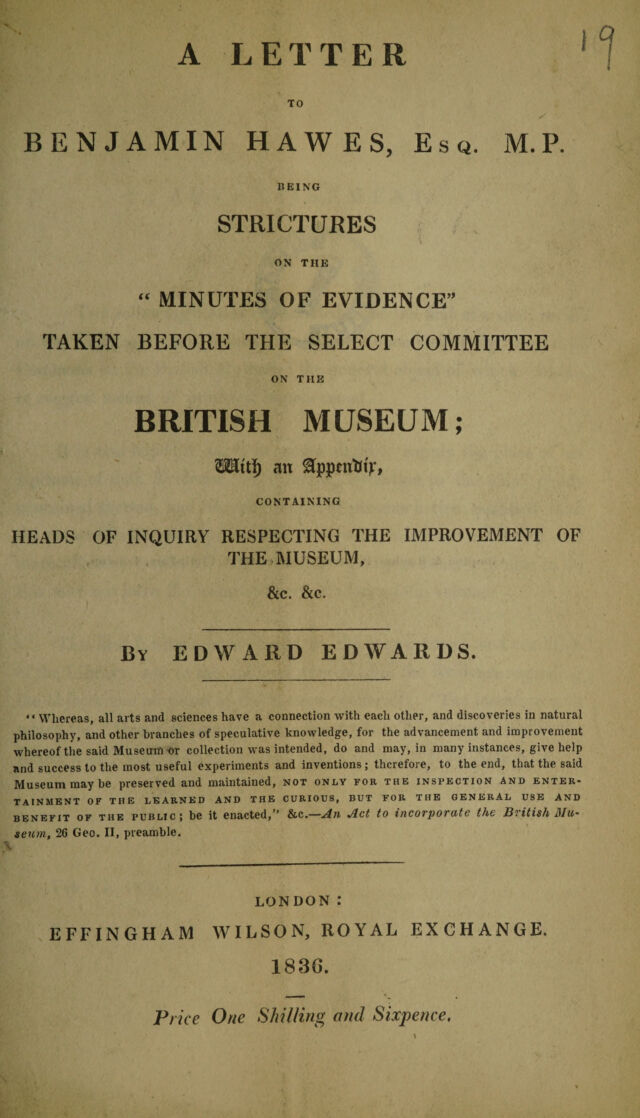
A letter to Benjamin Hawes, Esq., M.P., being strictures on the minutes of evidence taken before the Select Committee on the British Museum; with an appendix, containing heads of inquiry respecting the improvement of the Museum / [Edward Edwards].
- Edward Edwards
- Date:
- 1836
Licence: Public Domain Mark
Credit: A letter to Benjamin Hawes, Esq., M.P., being strictures on the minutes of evidence taken before the Select Committee on the British Museum; with an appendix, containing heads of inquiry respecting the improvement of the Museum / [Edward Edwards]. Source: Wellcome Collection.
27/60 page 27
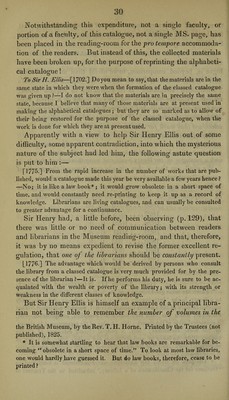
![How often this labour is really undertaken, I know not; but I do know that the information is wanted almost daily. The catalogues of the printed books are chiefly in two series ; first, the printed catalogue of 1812, with MS. enlargements (now far exceeding the original in bulk) in 22 vols. folio; and, secondly, the catalogue of the Library of George III, in 5 vols. imperial folio, with an addendum; both alphabetical: there is no general classed catalogue—[1685—Sir Henry Ellis.~\] The examination proceeds with reference to the comparative utility and importance of classed and alphabetical catalogues. [1690.] Then, to ascertain what works you have on a particular subject, a classed catalogue is considered indispensable ?—1 do not know that a classed catalogue is indispensable; an alphabetical one is ; an alphabetical one is referred to five hundred times where a classed catalogue is referred to once. [1691.] And where an alphabetical one does not give the information re¬ quired, as it cannot do by not shewing all the works in the library on a par¬ ticular subject, the classed catalogue is referred to ?—Yes ; that which is in [and is only a catalogue of] the king’s library. [1692.] But if it is useful in the king’s library, it would be useful in any other ?—Certainly. [1693.] Will you favour the Committee with your opinion of the compa¬ rative value of an alphabetical catalogue and a classed catalogue ?—An al¬ phabetical catalogue is indispensable; a classed catalogue is only occasion¬ ally useful. The men who come to our reading-room are mostly men of la¬ borious research, and men who are well acquainted with the subjects they are reading or writing upon ; and, therefore, a classed catalogue is not so often asked for as you might imagine. I do not mean to deny the utility of a classed catalogue; but I think the making of a perfect alphabetical one ought to be a prior employment; and the completion of a perfect alphabeti¬ cal one is the most important of the two to effect. * * * * [1697.] Will you state to the Committee, having now given your opinion * Of the King’s Library (that of George III, mentioned above) there is a classed catalogue in manuscript, made by Sir Frederick Barnard, at Buck¬ ingham House; but this is not in the reading-room. The existence of this catalogue was unknown to the writer, notwithstanding he had very frequently complained of the great want of n classed catalogue in the reading-room, until he chanced the other day to see it mentioned in the Report of the Par¬ liamentary Committee of 1823 (S. P. vol. 4). In what Sir Henry Ellis says of the frequent use of this catalogue [1685-9] he must certainly be under a mistake, as far as the reading-room is concerned.](https://iiif.wellcomecollection.org/image/b31915097_0027.jp2/full/800%2C/0/default.jpg)

 No text description is available for this image
 No text description is available for this image
 No text description is available for this image