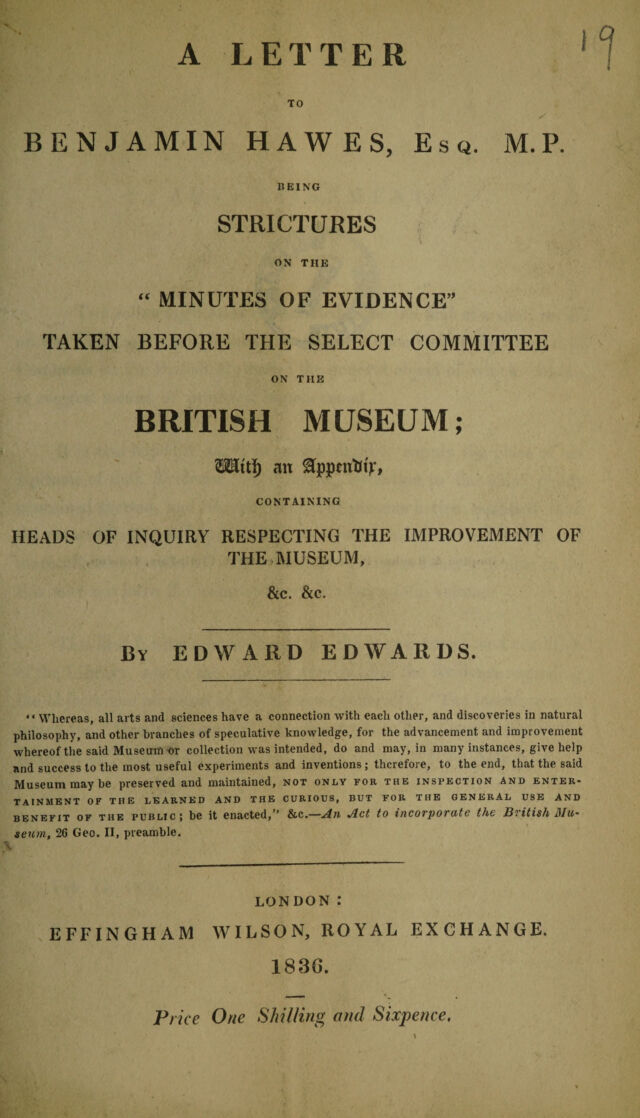
A letter to Benjamin Hawes, Esq., M.P., being strictures on the minutes of evidence taken before the Select Committee on the British Museum; with an appendix, containing heads of inquiry respecting the improvement of the Museum / [Edward Edwards].
- Edward Edwards
- Date:
- 1836
Licence: Public Domain Mark
Credit: A letter to Benjamin Hawes, Esq., M.P., being strictures on the minutes of evidence taken before the Select Committee on the British Museum; with an appendix, containing heads of inquiry respecting the improvement of the Museum / [Edward Edwards]. Source: Wellcome Collection.
28/60 page 28
![that it is very desirable there should be such a catalogue, why it was discon- * tinued?—The trustees have discontinued it for a time, until they can get a good alphabetical catalogue completed. [1698.] Why should they not be going on simultaneously?—The labour is immense, and the expense would be very great, to be carrying on both catalogues in full force at the same time. Surely, was never a simple question more marvellously mystified than this, of the comparative importance of classed and alphabetical catalogues to a public library. A good classed catalogue always includes an alphabetical catalogue in the shape of an “ index of authors’ names,” i. e. precisely the very thing, for all purposes of alphabetical reference, in order to obtain which, according to Sir Henry Ellis, the classed catalogue was abandoned. Mr. Horne’s plan did include this. The argument, then, is utterly fallacious, even upon Sir Henry’s own premises— that alphabetical reference is more required,—is more generally useful, than scientific reference. But are these premises true? An alphabetical catalogue, arranged, as are the catalogues of the British Museum, according to authors’ names, can only be useful to the reader who knows the name of the author whose book he wishes to consult, and who also requires to consult hut one work on a given subject. If he do not know the author’s name, and attempt to find the book he is in quest of by its title, he will commonly have to search in three or four places ; in the Museum catalogues he will frequently have to search half a dozen or even a dozen places, before he can be certain whether or not the book be there. If, again, knowing the authors’ names, he re¬ quire several works; in an alphabetical catalogue he must refer to several volumes,—in a classed catalogue he need refer but to one. On the other hand, to the reader who wishes to study a sub¬ ject, a classed catalogue is vitally important; for his object is to know what has been written on that subject. Is he a “man of laborious research ?” So much the more im¬ portant is it that his time be not thrown away. But, says Sir Henry Ellis, he is then “ well acquainted” with the writers on his subject. How did he acquire that knowledge—by the books](https://iiif.wellcomecollection.org/image/b31915097_0028.jp2/full/800%2C/0/default.jpg)

 No text description is available for this image
 No text description is available for this image
 No text description is available for this image