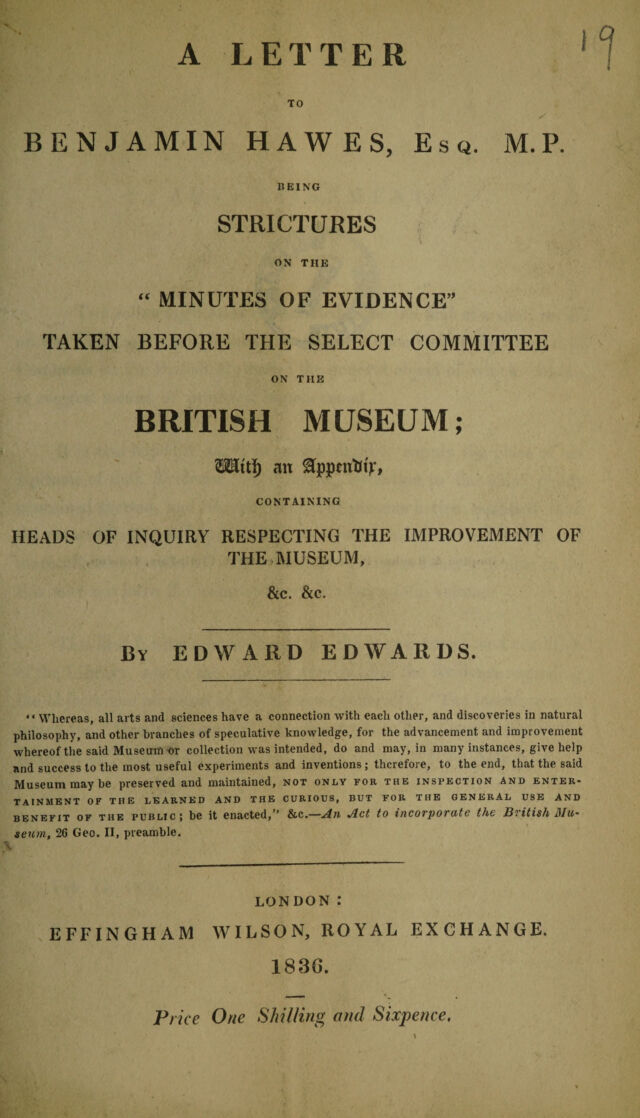
A letter to Benjamin Hawes, Esq., M.P., being strictures on the minutes of evidence taken before the Select Committee on the British Museum; with an appendix, containing heads of inquiry respecting the improvement of the Museum / [Edward Edwards].
- Edward Edwards
- Date:
- 1836
Licence: Public Domain Mark
Credit: A letter to Benjamin Hawes, Esq., M.P., being strictures on the minutes of evidence taken before the Select Committee on the British Museum; with an appendix, containing heads of inquiry respecting the improvement of the Museum / [Edward Edwards]. Source: Wellcome Collection.
32/60 page 32
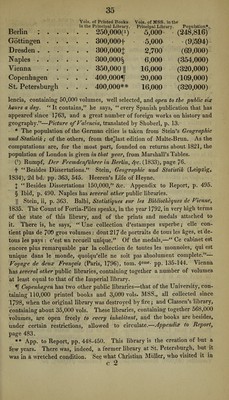
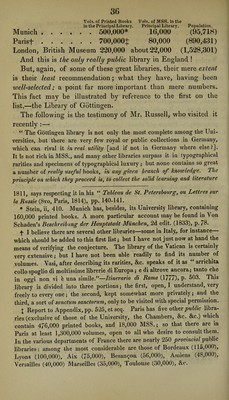
![[1778.] Is it not easier for the librarian to travel on with the accumula¬ tion of books, so as to know all that is to be found on the different subjects, than to go on correcting your classed catalogue with the rapidity you require to keep pace with the collection ?—It is. * * * * [1786.] If a classed catalogue is to be made at all, it should be done as quickly as possible by the same hands, in order that the same ideas should remain in the classification throughout?—Yes, that unity of design may be preserved. [1787-] If you had the same hands, you would have the same ideas as to what heads the books should be classed under?—You would, if one person drew the original outline on which the others were to act. [1788.] Then the question of expense would be the principal question to be considered?—Yes. [1789.] And that would be more for Parliament to consider than the Trustees of the British Museum ?—Certainly. Here, then, we arrive at the same result as formerly with re¬ gard to the extension of the hours of the reading-room, i. e.,that the question of completing a classed catalogue is one of expense, and of nothing else. The breaking up of the materials of the ca¬ talogue, after so large an expenditure, and without the slightest hint in Parliament of any disinclination to continue that expen¬ diture so long as it might be necessary, is a proceeding which it is impossible to justify. There is another point—much mixed up in the evidence with the question of catalogues—which deserves separate notice. I allude to the extraordinary want of acquaintance evinced on the part of the British Museum with the condition and proceedings of museums and libraries abroad. Sir Henry Ellis is asked,— [1764.] Do classed catalogues exist generally in foreign libraries?—I do not think they do. There is none at Paris, for instance, and that is a very large library ; I mean none for the last half century. I do not know that I have seen a classed catalogue in any great foreign library. The foreign libraries have given up printing catalogues generally Literature has accu¬ mulated so much, that a catalogue would find no purchaser if it was published. One would have thought that a very good reason why cata¬ logues should be printed, and why people should buy them. Surely, Sir Henry Ellis has an unconscionable notion of the duties and capabilities of “ living classed catalogues/7 [2399,] You were asked, on a former occasion, whether classed catalogues](https://iiif.wellcomecollection.org/image/b31915097_0032.jp2/full/800%2C/0/default.jpg)
 No text description is available for this image
 No text description is available for this image
 No text description is available for this image