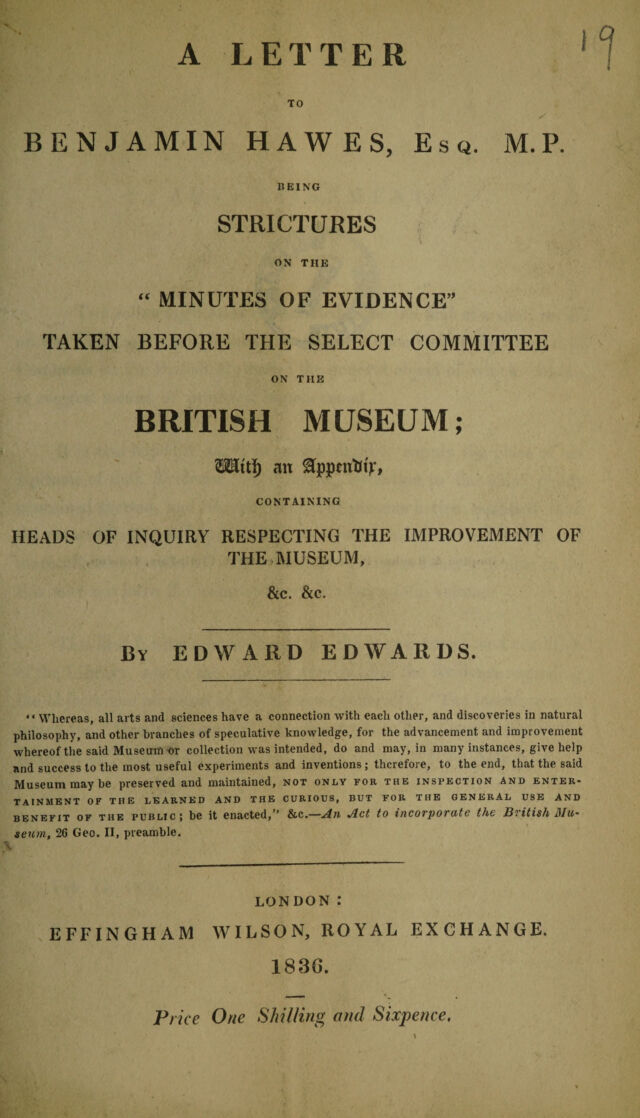
A letter to Benjamin Hawes, Esq., M.P., being strictures on the minutes of evidence taken before the Select Committee on the British Museum; with an appendix, containing heads of inquiry respecting the improvement of the Museum / [Edward Edwards].
- Edward Edwards
- Date:
- 1836
Licence: Public Domain Mark
Credit: A letter to Benjamin Hawes, Esq., M.P., being strictures on the minutes of evidence taken before the Select Committee on the British Museum; with an appendix, containing heads of inquiry respecting the improvement of the Museum / [Edward Edwards]. Source: Wellcome Collection.
47/60 page 47
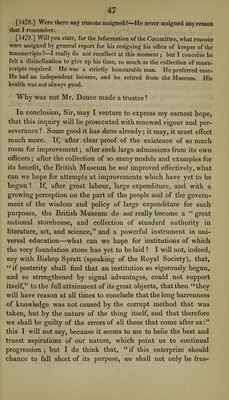
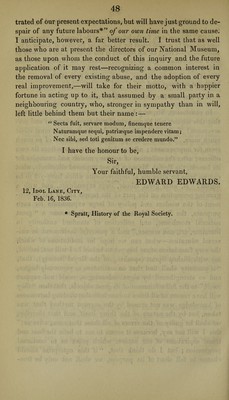
![[14/8.] Were there any reasons assigned?—He never assigned any reason that I remember. . .. , . [1479.] Will you state, for the information of the Committee, what reasons were assigned by general report for his resigning his office of keeper of the manuscripts?—I really do not recollect at this moment; but I conceive he felt a disinclination to give up his time, so much as the collection of manu¬ scripts required. He was a strictly honourable man. He preferred ease. He had an independent income, and he retired from the Museum. His health was not always good. Why was not Mr. Douce made a trustee? <*•••*• > In conclusion, Sir, may I venture to express my earnest hope, that this inquiry will be prosecuted with renewed vigour and per¬ severance? Some good it has done already; it may, it must effect much more. If, after clear proof of the existence of so much room for improvement; after such large admissions from its own officers; after the collection of so many models and examples for its benefit, the British Museum be not improved effectively, what can we hope for attempts at improvements which have yet to be begun ? If, after great labour, large expenditure, and with a growing perception on the part of the people and of the govern¬ ment of the wisdom and policy of large expenditure for such purposes, the British Museum do not really become a “ great national storehouse, and collection of standard authority in literature, art, and science,” and a powerful instrument in uni¬ versal education—what can we hope for institutions of which the very foundation stone has yet to belaid? I will not, indeed, say with Bishop Spratt (speaking of the Royal Society), that, “ if posterity shall find that an institution so vigorously begun, and so strengthened by signal advantages, could not support itself,” to the full attainment of its great objects, that then “they will have reason at all times to conclude that the long barrenness of knowledge was not caused by the corrupt method that was taken, but by the nature of the thing itself, and that therefore we shall be guilty of the errors of all those that come after us:” this I will not say, because it seems to me to belie the best and truest aspirations of our nature, which point us to continual progression ; but I do think that, “ if this enterprize should chance to fall short of its purpose, we shall not only be frus-](https://iiif.wellcomecollection.org/image/b31915097_0047.jp2/full/800%2C/0/default.jpg)
 No text description is available for this image
 No text description is available for this image
 No text description is available for this image