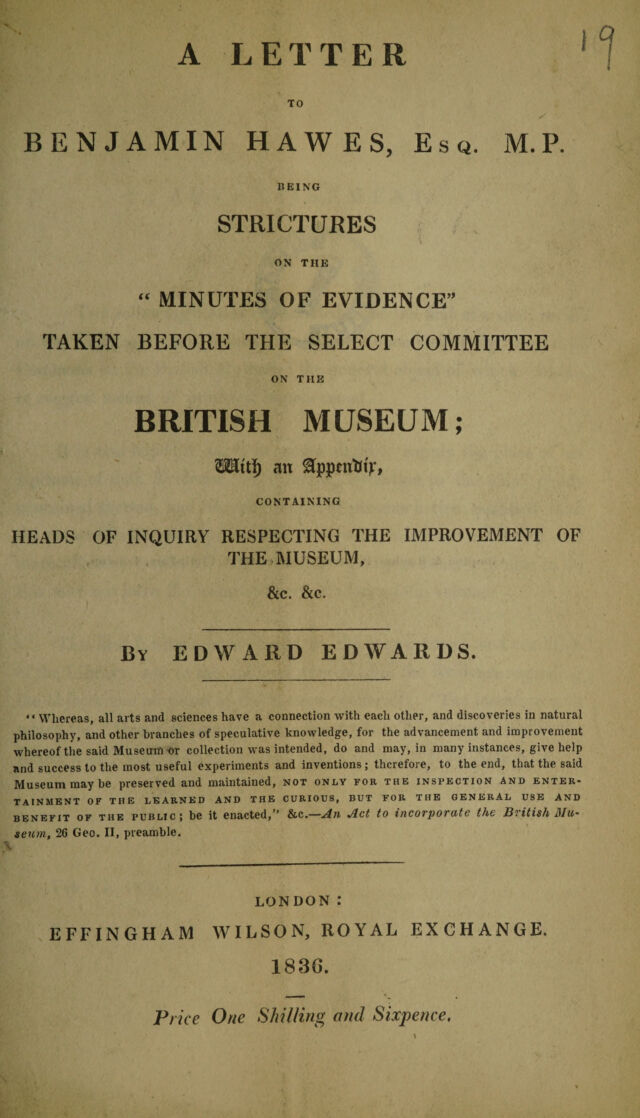
A letter to Benjamin Hawes, Esq., M.P., being strictures on the minutes of evidence taken before the Select Committee on the British Museum; with an appendix, containing heads of inquiry respecting the improvement of the Museum / [Edward Edwards].
- Edward Edwards
- Date:
- 1836
Licence: Public Domain Mark
Credit: A letter to Benjamin Hawes, Esq., M.P., being strictures on the minutes of evidence taken before the Select Committee on the British Museum; with an appendix, containing heads of inquiry respecting the improvement of the Museum / [Edward Edwards]. Source: Wellcome Collection.
6/60 page 6
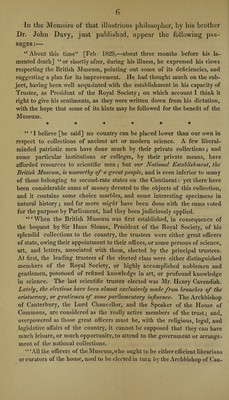
![Dr. John Davy, just published, appear the following pas¬ sages :— “About this time” [Feb 1829,—about three months before his la¬ mented death] “or shortly after, during his illness, he expressed his views respecting the British Museum, pointing out some of its deficiencies, and suggesting a plan for its improvement. He had thought much on the sub¬ ject, having been well acquainted with the establishment in his capacity of Trustee, as President of the Royal Society; on which account I think it right to give his sentiments, as they were written down from his dictation, with the hope that some of its hints may be followed for the benefit of the Museum. ****** “ ‘ I believe [he said] no country can be placed lower than our own in respect to collections of ancient art or modern science. A fewr liberal- minded patriotic men have done much by their private collections; and some particular institutions or colleges, by their private means, have afforded resources to scientific men ; but our National Establishment, the British Museum, is unworthy of a great people, and is even inferior to many of those belonging to second-rate states on the Continent: yet there have been considerable sums of money devoted to the objects of this collection, and it contains some choice marbles, and some interesting specimens in natural history; and far more might have been done with the sums voted for the purpose by Parliament, had they been judiciously applied. “ ‘ When the British Museum was first established, in consequence of the bequest by Sir Hans Sloane, President of the Royal Society, of his splendid collections to the country, the trustees were either great officers of state, owing their appointment to their offices, or some persons of science, art, and letters, associated with them, elected by the principal trustees. At first, the leading trustees of the elected class were either distinguished members of the Royal Society, or highly accomplished noblemen and gentlemen, possessed of refined knowledge in art, or profound knowledge in science. The last scientific trustee elected was Mr. Henry Cavendish. Lately, the elections have been almost exclusively made from branches of the aristocracy, or gentlemen of some parliamentary influence. The Archbishop of Canterbury, the Lord Chancellor, and the Speaker of the House of Commons, are considered as the really active members of the trust; and, overpowered as those great officers must be, with the religious, legal, and legislative affairs of the country, it cannot be supposed that they can have much leisure, or much opportunity, to attend to the government or arrange¬ ment of the national collections. “‘All the officers of theMuseum,wlio ought to be either efficient librarians or curators of the house, used to be elected in turn by the Archbishop of Can-](https://iiif.wellcomecollection.org/image/b31915097_0006.jp2/full/800%2C/0/default.jpg)