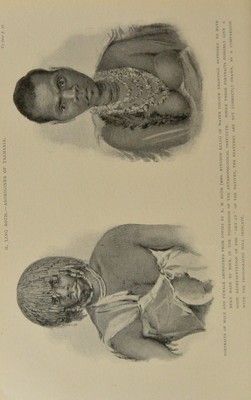
The aborigines of Tasmania / by H. Ling Roth ; assisted by Marion E. Butler and Jas. Backhouse Walker ; with a chapter on the osteology by J.G. Garson.
- Henry Ling Roth
- Date:
- 1899
Licence: Public Domain Mark
Credit: The aborigines of Tasmania / by H. Ling Roth ; assisted by Marion E. Butler and Jas. Backhouse Walker ; with a chapter on the osteology by J.G. Garson. Source: Wellcome Collection.
53/402 (page 19)
![PHYSICAL POWERS. before we encountered two women, who, from the top of a neighbouring hill, were directing their steps towards the sea-shore. . . . My companions started to pursue them, but had hardly gone 200 paces when the women, whom they thought easily to overtake, were already out of sight : this I had predicted beforehand, having had several opportunities of convincing myself that “the inhabitants of these shores were in general much swifter in running than we were.” In describing an interview with fourteen male aborigines, P6ron says (pp. 285-286) : “ Wishing at any cost to repeat certain observations which I had already begun in the Channel [d’Entrecasteaux] on the development of the physical powers of the people of these regions, I had Regnier’s dynamometer brought from the boat, where I had till then left it. I hoped that the form and use of the instrument might perhaps fix the attention of the savages whom I wished to submit to its test. I was not mistaken. They admired the instrument; all wished to touch it at the same time, and I had great trouble in preventing its being broken. After giving them an idea of the objedt in view by a series of attempts ourselves, we began to make them acft them- selves on the instrument : seven individuals had already submitted, when one of them, who had previously tried, and had been unable to make the needle of the dynamometer go as far as I could, appeared indignant at this impotence, and, as if to give the instrument the lie direct, he seized my wrist angrily, and seemed to defy me to disengage myself. I succeeded, however, after a few efforts, and having in turn seized him with all my strength, he was unable, in spite of all his endeavours, to free himself, which seemed to cover him with confusion and fill him with anger.” Later on he continues (p. 449) : “ Nevertheless, all my [dyna- mometrical] observations having been made on the best constituted individuals of the nation, and the results being very decided and, above all, certain, one can, without fear of mistake, apply these results to the generality of the people of this race : they indicate a want of vigour truly remarkable : in fact, although my experiments had been repeated on the most vigorous class of the population—those from eighteen to forty years of age—not a single V. D. Lander was able to press the needle beyond the 60th degree, and the mean of the twelve observations which I was able to make was only 50-6 kilogrammes. . . . The opposing strength of man to man confirms these a priori returns of the instrument. Qur sailors always won when they wrestled with the savages, and the latter were not luckier with one of our officers, Maurouard ; the one amongst them that seemed to us the most robust . . . wished to provoke him to wrestle the officer threw him easily, several times running, and my own experience had like results.” Peron’s similar experiments carried out among other people gave the following results for their manual force expressed in kilogrammes (p. 456) :— Van Diemen’s Landers ... ... ... ... 50-6 New Hollanders (Australians) ... ... ... 51-8 Natives of Timor ... ... ... ... ... 58’7 Frenchman ... ... ... ... ... ... 69-2 Englishman ... ... ... ... ... ... 71^4 “ The ages given in the table, on p. 20, are only approximately correct, the numerical system of the people of Van Diemen’s Land and New](https://iiif.wellcomecollection.org/image/b24885642_0053.jp2/full/800%2C/0/default.jpg)