On a collection of dragonflies made by members of the Skeat expedition in the Malay peninsula in 1899-1900. [Pt. I] / by F.F. Laidlaw.
- Frank Fortescue Laidlaw
- Date:
- 1902
Licence: In copyright
Credit: On a collection of dragonflies made by members of the Skeat expedition in the Malay peninsula in 1899-1900. [Pt. I] / by F.F. Laidlaw. Source: Wellcome Collection.
Provider: This material has been provided by The Royal College of Surgeons of England. The original may be consulted at The Royal College of Surgeons of England.
14/36 page 74
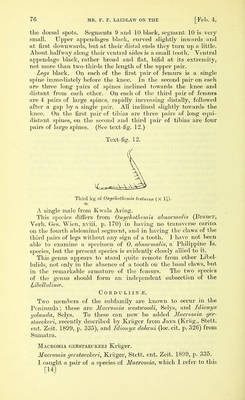
![running from the second and third femora to between the wings. The whole ventral surface is yellowish brown, and this colour extends for a short distance along the humeral suture and on to the sides of the metasternum. Between the wings dorsally are three yellow spots, one behind the other. Abdomen black, very slightly dilated fit its base. Yellow lateral spots on segments 1, 2, 3. Base of segments 2, 3, 4 with a fine transverse yellow line; mid-dorsal carina with a scarcely perceptible yellow line from segments 3 to 7. Longitudinal yellow marks ventrally on segments 3, 4, 5 on either side of the middle line. Anal appendages black. Transverse carinse on segments 2, 3. On segment 2 there is on either side anteriorly a small tuft of fine black hairs. Legs black. In the male the second pair of femurs have each a row of 18 antero-inferior short spines directed towards the knee, and increasing in size gradually from above downwards. These are followed after a short gap by three long straight spines which are also directed a little downwards (see text-fig. 11). The third pair of femurs have each 26 antero-inferior short subequal spines all directed towards the knee, save the last six, which are nob inclined. Then folio^v two longer spines inclined towards the knee. Text-fig. 11. Second femur of Zygonidia inalayana. This species differs from Zygonyx iris chiefly in that the discoidal triangle of the lower wing is followed by two rows of cells, not by three; and in the absence of any dorsal markings on segment 7 of the abdomen, in the coloration of the thorax, and length of the pterostigma. It is more closely allied to Zygonidia hisignis (Kirby, A. M. N. H. (7) v. p. 540), from which it is chiefly distinguished by its smaller size, the fewer reticulations in the postnodal spaces of the hind wings, and in the details of the spines on the second and third pairs of femurs of the male. In Z. insignis the second pair of femurs have each a row of 18 antero-inferior spines, followed by three much longer spines. The first 12 are directed towards the knee, the next six are not inclined, the three long spines are slightly inclined towards the knee. The third pair of femurs have each some 24 short spines, the first 14 inclined towards the knee, the last 10 scarcely inclined, followed by two longer spines inclined to the knee. I caught two specimens of Zygonidia malayana at Kwala Aring in September. These, like all the other recorded s|>ecimens [12]](https://iiif.wellcomecollection.org/image/b22406566_0016.jp2/full/800%2C/0/default.jpg)