On a collection of dragonflies made by members of the Skeat expedition in the Malay peninsula in 1899-1900. [Pt. I] / by F.F. Laidlaw.
- Frank Fortescue Laidlaw
- Date:
- 1902
Licence: In copyright
Credit: On a collection of dragonflies made by members of the Skeat expedition in the Malay peninsula in 1899-1900. [Pt. I] / by F.F. Laidlaw. Source: Wellcome Collection.
Provider: This material has been provided by The Royal College of Surgeons of England. The original may be consulted at The Royal College of Surgeons of England.
15/36 page 75
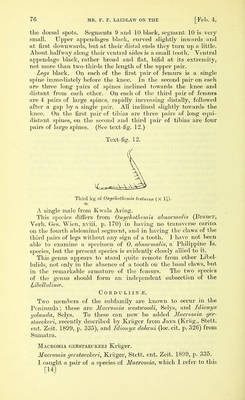
![belonging either to the genus Zygonidia or to Zygonyx, are both males. The character of the last antenodal cross nervnle seems to be very variable. In one specimen of Zygonyx iris it is accident- ally complete (de Selys, C. R. Soc. Ent. Belg. xxxv. p. ccxxvii). In one of the two known specimens of Zygonidia msignis it is accidentally incomplete on one side (Kirby, A. M. N. H. (7) v. p. 540). On one side of both specimens described above it is incomplete, on the other complete. These two preceding species, together with their allies, pro- bably constitute a separate section of the Lihellidmce approxi- mating somewhat closely to the Cordidiincp.. See Calvert, loc.cit. Onychothemis testacea, sp. n. (Plate Y. fig. 2.) Length of abdomen 33‘5 mm. Length of hind wing 40 mm. Length of anal app. of d 2’5. Breadth of hind wing 13‘5 mm. Wings hyaline, reticulation black. Pterostigma 4 mm. long. Fore wi7igs.'15 antenodals, 10-11 postnodals. Internal tri- angle divided into three cells. Discoidal triangle narrow, with a single cross vein, followed by three rows of cells; no supra-tri- angular nervule. Nodal sector waved, a single ci*oss nervnle in the lower basal space ; membranule long, grey. Upper sector of triangle curved. Sectors of arculus stalked. Hind wmgs. 9-10 antenodals, 11 postnodals. Discoidal triangle free, followed by two rows of cells. Lower basal cell with a single cross nervule. Sectors of tiiangle originate close together. Nodal sector waved. Head. Ventral surfaces yellow, with a triangular black mark in the centre, its apex directed forwards. Upper lip black, with a reddish-brown spot on either side. Bhinarium and nasus reddish brown, with a black mark along the suture between them. Frons yellow below, steely black above. Frontal tubercle bifid, steely black. Occipital triangle black. Frothorax black, with a yellow hinder mar gin. Thorax dark metallic green, the mid-dorsal carina and a mid- dorsal line between the wings yellow. Two small orange-yellow spots on the humeral sutures on either side, the one above the other. A thin yellow band runs from immediately behind the front pair of wings downwards to between the second and third pairs of legs on either side. An orange line runs along the outer- edge of the metasternum. Ventral surface black. Abdomen broad, slightly dilated at its base. Segments 4 to 8 strongly triangular in section. Testaceous black with dull yellow markings. Mid-dorsal spots on the middle of segments 1 to 8. Segments 2 and 3 with a yellow-marked transvei-se carina; the yellow mark is discontinuous dorsally in 2, but in 3 runs into the yellow spot. Ventrally each segment from 3 to 8 has two large oblong yellowish spots on either side of the middle line. These spots extend round the lateral keel on to the sides of the abdomen and on segment 7, 8 reach to within a short distance of [13]](https://iiif.wellcomecollection.org/image/b22406566_0017.jp2/full/800%2C/0/default.jpg)