The relation of Richard Rush to the Smithsonian institution / by Cyrus Adler.
- Cyrus Adler
- Date:
- [1910]
Licence: In copyright
Credit: The relation of Richard Rush to the Smithsonian institution / by Cyrus Adler. Source: Wellcome Collection.
12/52 page 238
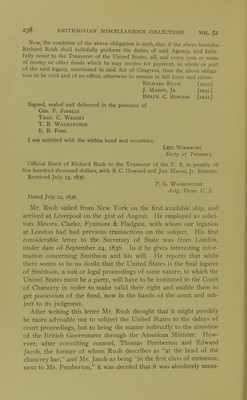
![Now, the condition of the above obligation is such, that, if the above bounden Richard Rush shall faithfully perform the duties of said Agency, and faith- fully remit to the Treasurer of the United States, all, and every sum or sums of money or othei funds which he may receive for payment, in whole or part of the said legacy, mentioned in said Act of Congress, then the above obliga- tion to be void and of no effect, otherwise to remain in full force and virtue. Richard Rush [seal] J. Mason, Jr. [seal] Benjn. C. Howard [seal] Signed, sealed and delivered in the presence of Geo. P. Forrest Thos. C. Wright T. B. Washington E. R. Ford. I am satisfied with the within bond and securities. Levi Woodbury Secty of Treasury. Official Bond of Richard Rush to the Treasurer of the U. S. in penalty of five hundred thousand dollars, with B. C. Howard and Jno. Mason, Jr. Sureties. Received July 13, 1836. P. G. Washington Actg. Treas. U. S. Dated July 12, 1836. Mr. Rush sailed from New York on the first available ship, and arrived at. Liverpool on the 31st of August. He employed as solici- tors Messrs. Clarke, Fynmore & Fladgate, with whom our legation at London had had previous transactions on the subject. His first considerable letter to the Secretary of State was from London, under date of September 24, 1836. In it he gives interesting infor- mation concerning Smithson and his will. He reports that while there seems to be no doubt that the United States is the final legatee of Smithson, a suit or legal proceedings of some nature, to which the United States must be a party, will have to be instituted in the Court of Chancery in order to make valid their right and enable them to get possession of the fund, now in the hands of the court and sub- ject to its judgment. After writing this letter Mr. Rush thought that it might possibly be more advisable not to subject the United States to the delays of court proceedings, but to bring the matter indirectly to the attention of the British Government through the American Minister. How- ever, after consulting counsel, Thomas Pemberton and Edward Jacob, the former of whom Rush describes as “at the head of the chancery bar,” and Mr. Jacob as being “in the first class of eminence, next to Mr. Pemberton,” it was decided that it was absolutely neces-](https://iiif.wellcomecollection.org/image/b24865448_0012.jp2/full/800%2C/0/default.jpg)

 No text description is available for this image
 No text description is available for this image
 No text description is available for this image