Origin and growth of sheep husbandry in the United States with some remarks on Angora fleece.
- United States Department of Agriculture
- Date:
- 1880
Licence: Public Domain Mark
Credit: Origin and growth of sheep husbandry in the United States with some remarks on Angora fleece. Source: Wellcome Collection.
102/158 (page 88)
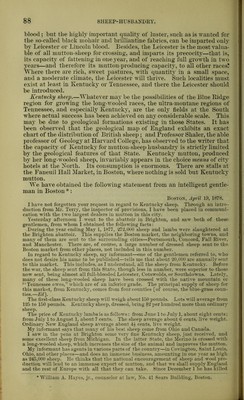
![blood; but the highly important quality of luster, such as is wanted for the so-called black mohair and brilliantine fabrics, can be imparted only by Leicester or Lincoln blood. Besides, the Leicester is the most valua- ble of all muttou-sheep for crossing, and imparts its precocity—that is, its capacity of fattening in one year, and of reaching full growth in two years—and therefore its mutton-producing capacity, to all other races! Where there are rich, sweet pastures, with quantity in a small space, and a moderate climate, the Leicester will thrive. Such localities must exist at least in Kentucky or Tennessee, and there the Leicester should be introduced. Kentucky sheep.—Whatever may be the possibilities of the Blue Bidge region for growing the long-wooled races, the ultra-montane regions of Tennessee, and especially Kentucky, are the only fields at the South where actual success has been achieved on any considerable scale. This may be due to geological formations existing in those States. It has been observed that the geological map of England exhibits an exact chart of the distribution of British sheep; and Professor Shaler, the able professor of Geology at Harvard College, has observed to the writer that the capacity of Kentucky for mutton-sheep husbandry is strictly limited by the geological features of that State. Kentucky mutton, produced by her long-wooled sheep, invariably appears in the choice menus of city hotels at the Korth. Its consumption is enormous. There are stalls at the Faneuil Hall Market, in Boston, where nothing is sold but Kentucky mutton. We have obtained the following statement from an intelligent gentle- man in Boston *: Boston, April 19, 1878. I have not forgotten your request in regard to Kentucky sheep. Through an intro- duction from Mr. Terry, the inspector of provisions, I have been placed in communi- cation with the two largest dealers in mutton in this city. Yesterday afternoon I went to the abattoir in Brighton, and saw both of these gentlemen, from whom I obtained the following facts: During the year ending May 1, 1877, 272,000 sheep and lambs were slaughtered at the Brighton abattoir. This supplies the Boston market, the neighboring towns, and many of them are sent to the surrounding cities—Portsmouth, Concord, Fall River, and Manchester. There are, of course, a large number of dressed sheep sent to the Boston market from other places, not included in this number. In regard to Kentucky sheep, my informant—one of the gentlemen referred to, who does not desire his name to be published—tells me that about 20,000 are annually sent to this market. This includes, as I understand, all the sheep from Kentucky. Before the war, the sheep sent from this State, though less in number, were superior to those now sent, being almost all full-blooded Leicester, Cotswolds, or Southdowns. Lately, many of these long-wooled sheep have been crossed with the native mountain or “ Tennessee ewes,” which are of an inferior grade. The principal supply of sheep for this market, from Kentucky, comes from four counties [of course, the blue-grass coun- ties.—EcL]. The first-class Kentucky sheep will weigh about 150 pounds. Lots will average from 125 to 150 pounds. Kentucky sheep, dressed, bring $2 per hundred more than ordinary sheep. The price of Kentucky lambs is as follows: from June 1 to July 1, about eight cents; from July 1 to August 1, about 7 cents. The sheep average about 6 cents, live weight. Ordinary New England sheep average about 44- cents, live weight. My informant says that many of his best sheep come from Ohio and Canada. I saw in the pens at Brighton some very fine Kentucky sheep, just received, and some excellent sheep from Michigan. In the latter State, the Merino is crossed with a long-wooled sheep, which increases the size of the animal and improves the mutton. My informant has agents in various parts of the country—in Covington, Saint Louis, Ohio, and other places—and does an immense business, amounting in one year as high as 245,000 sheep. He thinks that the national encouragement of sheep and wool pro- duction will lead to an immense export of mutton, and that we shall supply England and the rest of Europe with all that they can take. Since December 1 he has killed * William A. Hayes, jr., counselor at law, No. 41 Sears Building, Boston.](https://iiif.wellcomecollection.org/image/b28127948_0102.jp2/full/800%2C/0/default.jpg)