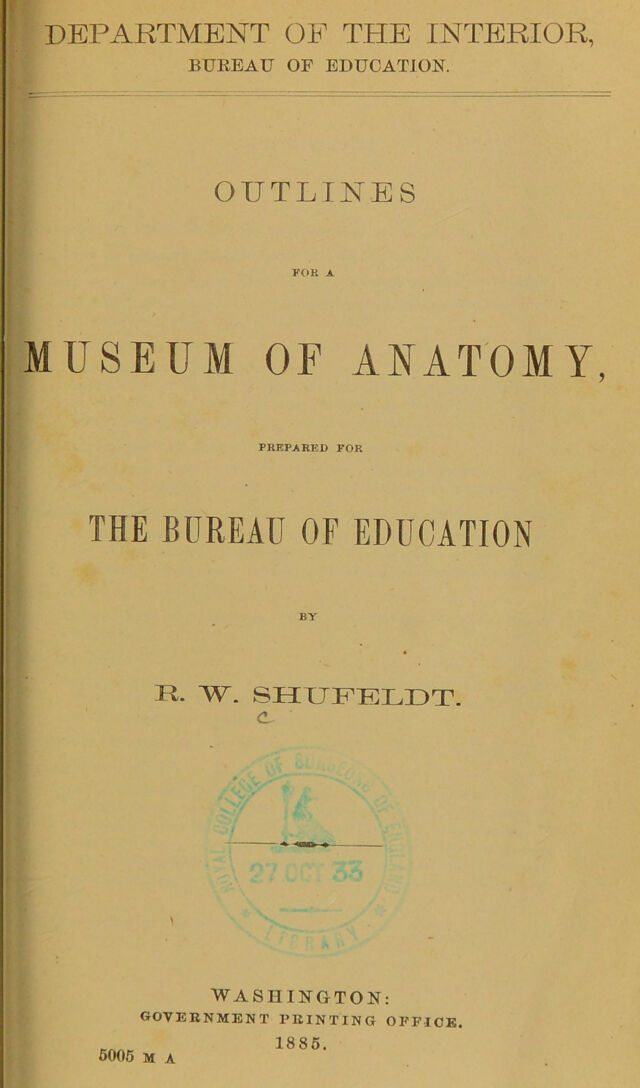
Outlines for a Museum of Anatomy / prepared for the Bureau of Education.
- Robert Wilson Shufeldt
- Date:
- 1885
Licence: Public Domain Mark
Credit: Outlines for a Museum of Anatomy / prepared for the Bureau of Education. Source: Wellcome Collection.
Provider: This material has been provided by The Royal College of Surgeons of England. The original may be consulted at The Royal College of Surgeons of England.
13/70 page 11
![event. Our museum must necessarily, however, present many, many gaps in such an all-absorbing scheme as this; still a very great num- ber of examples illustrating this law can be presented, as I intend to show further on—a number quite sufficient to enable one to appre- ciate its presence at every step and feel its truth, and see its wonderful beauty throughout. The arrangement of the specimens in a museum of anatomy and physiology in the future upon any other plan will sim- ply defeat the objects of the institution, and render it almost a useless place of resort for any one whose object it is to gain an idea of the broad principles that underlie morphology. Even if it were proper to do so here, I would no moi'e think, at this day, of undertaking to demonstrate the truth of the law of evolution, or make any apology for it in the present connection, than I would essay to do the same for Newton’s laws of gravitation, had they formed a i>art of my subject. Indeed, I regard it very much in thesame light; for, as Huxley says: Au iiiclnctive hypothesis is .said to he demonstrated when the facts are shown to be in entire accordance with it. If that is not scientiiic proof, there are no merely in- ductive conclusions which can he said to be proved. And the doctrine of evolution, at the present time, rests upon exactly as secure a foundation as the Coxiernioan theory of the motjons of the heavenly bodies did at the time of itsi)romulgatiou. Its logical basis is precisely of the same character,—the coincidence of the observed facts with theoretical requirements.' So far as we now comprehend them, the laws of evolution as they apply to morphology, physiologj’’, and psychology, are sufficiently well known to all cultured and reading j)eople to obviate the necessity of my presenting ever so brief a definition of them here. Moreover, much that refers to the subject I trust to make clear when we come to the dis- cussion of the separate specimens. The second law that the collection as a whole will be selected and ar- ranged by, and designed to illustrate, is, that in order to obtain a correct knoivledge of the anatom]] of any form we must have a general conception of the structure of all other forms in-nature^ and, as near as possible, an exact hnoicledge of those more nearly related to any special one we in- tend to study. In the case of man this is absolutely imperative, and it is the only road through which we will ever gain an exact knowledge of his structure. I not only refer to his gross anatomy, but particularly to the histology of man’s own form. Precisely the same methods of im esti- gation ajiply to the subject of physiology—a science, so far as our pres- ent knowledge of it goes, that is still in its infancy. I will present here but one instance of the operation of this law and what it leads to. Take the subject of medicine and surgery : medicine and surgery progress and become perfected pari passu as our hnoicledge of pathology increases; our hnoicledge of pathology rests entirely upon our knowledge of jihysiology, and, as a rule, advances with it ; tee cannot know ‘ Huxley, Thoma.s H. Lectures on Evolution delivered in New Y^ork City, in Sep teniber, 1876. Published in various ])laceH.](https://iiif.wellcomecollection.org/image/b22470244_0015.jp2/full/800%2C/0/default.jpg)


 No text description is available for this image
 No text description is available for this image
 No text description is available for this image