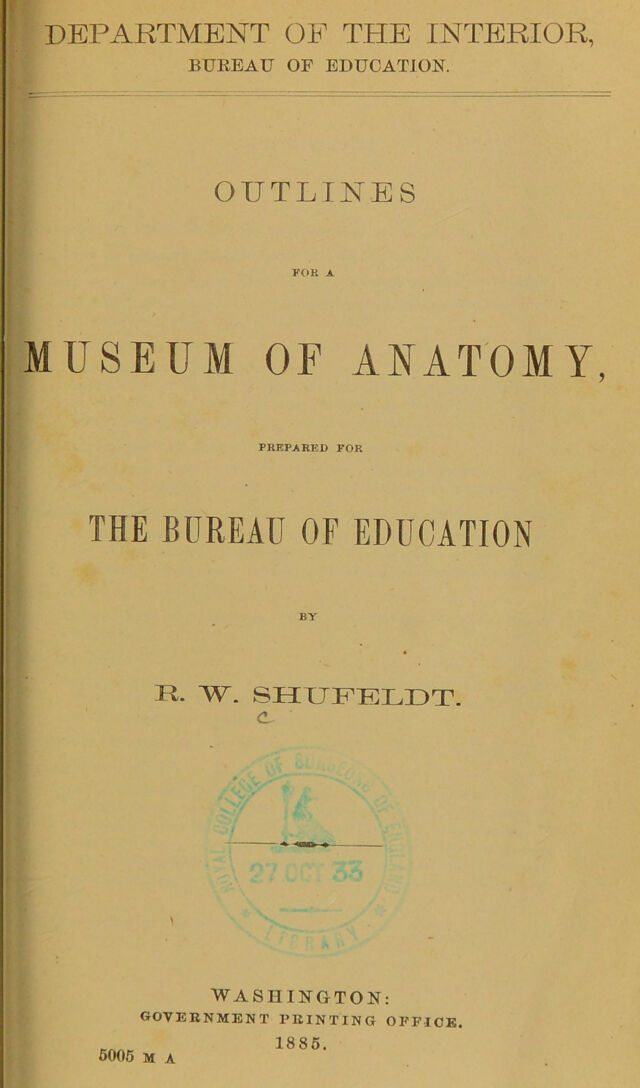
Outlines for a Museum of Anatomy / prepared for the Bureau of Education.
- Robert Wilson Shufeldt
- Date:
- 1885
Licence: Public Domain Mark
Credit: Outlines for a Museum of Anatomy / prepared for the Bureau of Education. Source: Wellcome Collection.
Provider: This material has been provided by The Royal College of Surgeons of England. The original may be consulted at The Royal College of Surgeons of England.
16/70 page 14
![The maguiflceiit monument Flint has raised to the same science^ breathes forth from every chapter the same conviction, and we all know wi^i what telling effect he has put it in iiractice. Students of luiinau anatomy appreciate this as well as the physiolo- gists, and truly is it said by one of the best of them that—“ human anatomy is thus in itself a widely extended science, and stands in close relations to neighboring and allied sciences. Man is an animal, and his anatomy should be regarded as a natural history monograph. He is built on the same principles as his neighbors, and in most respects he is the best primary type for us to study for the purposes of comparative anatomy. As no one type, however, suits for the demonstration of all morphological laws, and as many of the principles of animal organiza- tion can be better understood and illustrated by the study of simpler forms, we require, therefore, to make frequent calls upon other animals to explain obscure points in human anatomy, and thus human anatomy is brought into close relations with comparative anatomy.”^ The most able and learned men of our day advance the same opinion. So we must not be surprised to find, in the words of an eminent anatomist, that — Man is an animal, and feels; in other words, forms one of a multitude of ditferent kinds of organized and sentient beings, the bodies of which have obvious, but very various, relations with his body. It is clear, then, from the nature of the case, that man’s body can only be comprehended by means of an extensive acquaintance with the bodies of other animals. Experience confirms this conclusion, as the exclusive study of man’s body, though sufficient for the mere art of the surgeon, had led to quite er- roneous estimates of the nature and meaning of parts of it; errors corrected only through the general science of organic forms; i. e., the science of mor^ihology.” There is no doubt that many and many a human life has been sacri- ficed because the sui'geon was ignorant of human anatomy at the time ^ of his performing an operation. And it is very true, as the author ] whom I have just quoted says, that many of our erroneous notions of: human anatomy are due to the fact that we are so ignorant of the anat- omy of other vertebrates. The exhibition of each successive organ in all varieties and modifications discloses*| many aspects otherwise hidden, and places the more general and fundamental pecu- liarities in a strong light. Much of the insight that we at present possess regarding ;| the brain is due to comparative anatomy. Too great pains c.anuot be given to the perfecting of the comparative method, and the grand secret is the lucid presentation of agreements and of differences.'* . ^ ‘ A Text-book of Human Physiology, designed for the use of practitioners and students j of medicine. By Austin Flint, jr., M.D. New York, 187C. ^Alexander Macalister, M.D., F.R.S., Professor of Anatomy, University of Cam- bridge. Introductory lecture, On the Province of Anatomy, published in the Aledlcal Journal, p. 808. London, October 27, 1883. 3St. George Mivart, F.R.S., etc. Lessons in Elementary Anatomy, p. 1. London, 1877. Professor Mivart is a member of the faculty of St. Mai'y’s Hospital, and an author of several well known classical scientific woi’ks. Alexander Bain, LL.D., Professor of Logic in the University of Aberdeen. Logtc, Deductive and Inductive, p. 539. New York, 1874.](https://iiif.wellcomecollection.org/image/b22470244_0018.jp2/full/800%2C/0/default.jpg)


 No text description is available for this image
 No text description is available for this image
 No text description is available for this image