Outlines for a Museum of Anatomy / prepared for the Bureau of Education.
- Robert Wilson Shufeldt
- Date:
- 1885
Licence: Public Domain Mark
Credit: Outlines for a Museum of Anatomy / prepared for the Bureau of Education. Source: Wellcome Collection.
Provider: This material has been provided by The Royal College of Surgeons of England. The original may be consulted at The Royal College of Surgeons of England.
23/70 page 21
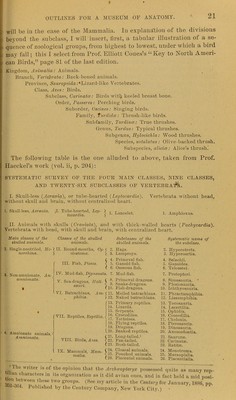
![t OUTLINES FOR A MUSEUM OF ANATOMY. •' 21 will be iu the case of the Mammalia, lu explanation of the divisions beyond the subclass, I will insert, first, a tabular illustration of a se- quence of zoological groups, from highest to lowest, under which a bird may fall; this 1 select from Prof. Elliott Coues’s “Key to North Ameri- can Birds,” page 81 of the last edition. Kingdom, Animalia: Auimals. Branch, Vertebrata: Back-boned animals. Province, ASttitroj)sida;*Lizard-like Vertebrates. Class, Avts: Birds. Snbclfxss, CarinaUe: Birds with keeled breast bone. Order, Passeres; Perching birds. Suborder, Oscines: Singing birds. Family, Ttirdidw: Thrush-like birds. Subfamily, Tm-dina; True thrushes. Genus, Turdua; Typical thrushes. Subgeuus, Hylocichla; Wood thrushes. Species, natulatus : Olive-backed thrush. Subspecies, ah'cice: Alice’s thrush.' The following table is the one alluded to above, taken from Prof. Haeckel’s work (vol. ii, p. 204): SYSTEMATIC SURVEY OF THE FOUR MAIN CLASSES, NINE CLASSES, AND TWENTY-SIX SUBCLASSES OF VERTEBRA'A. I. Skull-less (Acravia), or tube-hearted (Leplocardia). without skull and brain, without centralized heart. Vertebrata without head, 1. Skull-les.s, Acrania. II. Animals with skulls (Cmniota), and with thick-walled Vertebrata W'ith head, with skull aud brain, with centralized Main classes of the skulled animals. Classes of the skulled animals. 2. Single-nostrilecI, Mo- ? II. RouDd-raouths, Gy- C 2. norrhina. 3 clostoma. j 3. f in. Fish, Pisces. ^ H. I 6. 3. Non-amnioiiate, J lY. Mud-flsh, IMpnejata. 7. amnionata. t V. Sea-dragons, Mali- ” ’ 0. 110. ^ VI. Batrachians, Am- < 11. ) 12. sauH. ■phibia. ' VII. Reptiles, Peptilia. I. Amnionato animals, i Amnionata. 13. 14. 1.7. 10. 18. 19. 120. VIII. Birds, Aves f21. t. ^ 22. <23. IX. Mammals, Mam- J malia. 1 Subclasses of the skulled animals. Hags. Lampreys. Primeval fish. Ganoid fish. Osseous fish. Mud-fish. Primeval dragons. Snake-dragons. Fish-dragons. Mailed hatiachians. Naked hatrachians. Primary reptiles. Lizards. Sei-])ents. Crocodiles. Toi toises. Flying reptiles. Dragons. Beaked reptiles. Loug-tailed.' Fan-tailed. Bosh-tailed. Cloacal animals. Pouched animals. Placental animals. 1. Amphioxus. hearts (Pachycardia). heart. Systematic name of the subclass. 2. Hyperotreta. 3. Hyperoartia. 4. Selachii. 5. Ganoides. 6. Teleostei. 7. Protopteri. 8. Simosauria. * 9. Plesiosauria. 10. Ichthyosaiiria. 11. Phractamphihia. 12. Lissamphihia. 13. Tooosauria. 14. Lacertilia. 15. Ophidia. 16. Crocodilia. 17. Chelonia. 18. Pterosauria. 19. Dinosauria. 20. Anomodontia. 21. Saurnrie. 22. Carinata3. 23. Ratitro. 24. Monotrema. 25. Mai-supialia. 20. Placeutialia. ■The writer is of the opinion that tlie Archwopteryx possessed quite as many rep- I lan characters in its organization as it did avian ones, and iu fact held a mid posi- tion between these two groups. (See my article in tbe Century for January, 1886. pp. Jb-J-ar,!. Publnshed by tbe Century Company, Now York City.) •](https://iiif.wellcomecollection.org/image/b22470244_0025.jp2/full/800%2C/0/default.jpg)




 No text description is available for this image
 No text description is available for this image
 No text description is available for this image